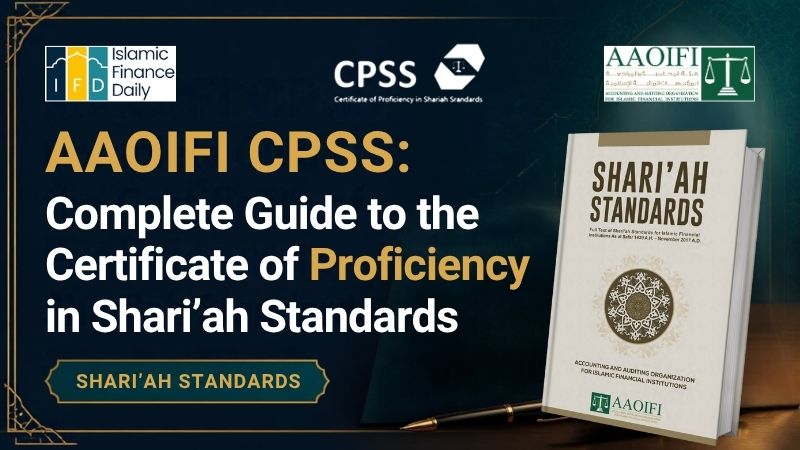
AAOIFI CPSS: Complete Guide to the Certificate of Proficiency in Shari’ah Standards
1. Introduction
The AAOIFI CPSS, or Certificate of Proficiency in Shari’ah Standards, is an advanced-level professional certificate focused on the understanding and practical application of the Shari’ah Standards issued by the Accounting and Auditing Organization for Islamic Financial Institutions (AAOIFI).
AAOIFI Shari’ah Standards provide a specialised framework for addressing Shari’ah requirements across Islamic finance transactions, contracts, products and institutional activities. For professionals working with Islamic financial institutions, understanding these standards is important because they provide detailed guidance on how various financial structures and transactions are to be designed, reviewed and implemented from a Shari’ah perspective.
CPSS is designed to develop a structured understanding of these standards, including the principles behind them and their practical application. Rather than focusing only on memorising individual requirements, the qualification is concerned with developing knowledge that can be applied to Islamic finance transactions and institutional practices.
The qualification may be relevant to a range of professionals, including those working in Islamic banking, Shari’ah advisory, Shari’ah review, Shari’ah compliance, Islamic finance, Takaful and Islamic capital markets. It may also be relevant to professionals who intend to progress through AAOIFI’s wider qualification framework, where CPSS forms part of the current pathways leading to CSAA and CIPA.
This guide explains the AAOIFI CPSS qualification in detail, including its purpose, eligibility, structure, syllabus, coverage of AAOIFI Shari’ah Standards, examination, fees, registration, study materials, preparation approach and professional relevance. It also explains where CPSS fits within AAOIFI’s current qualification framework.
2. What Is the AAOIFI CPSS Qualification?
The AAOIFI CPSS, short for Certificate of Proficiency in Shari’ah Standards, is an advanced-level professional certificate focused specifically on the AAOIFI Shari’ah Standards. The qualification is designed to develop a candidate’s ability to understand, interpret and apply these standards in the context of Islamic finance.
At its core, CPSS is concerned with the technical Shari’ah requirements that govern a wide range of Islamic financial transactions, contracts and institutional activities. The qualification therefore goes beyond a general introduction to Islamic finance. It requires candidates to engage with the detailed requirements contained in the relevant AAOIFI Shari’ah Standards and understand how those requirements relate to practical financial structures.
An important feature of CPSS is its emphasis on both knowledge and application. A candidate is expected to understand the requirements of the standards, but also to develop the ability to consider how those requirements operate in actual Islamic finance transactions and institutional environments. This makes the qualification relevant to professionals who need to work with Shari’ah requirements as part of their professional responsibilities.
The CPSS qualification covers the breadth of AAOIFI’s Shari’ah Standards across areas of Islamic finance. These standards address different contracts, financial products, markets and institutional practices. As a result, studying for CPSS requires candidates to develop a broad understanding of the Shari’ah framework used across the Islamic finance industry rather than concentrating on a single type of transaction.
CPSS is also an independent Certificate of Proficiency. It should not be understood merely as a component of another qualification. Candidates can pursue CPSS as a standalone certificate, while the certificate also forms part of AAOIFI’s current modular qualification pathways.
The practical value of the qualification therefore lies in developing structured knowledge of AAOIFI Shari’ah Standards and their application. For professionals involved in Islamic financial institutions, Shari’ah review, Shari’ah compliance, Islamic finance transactions or related areas, this knowledge can provide a more systematic understanding of the standards that underpin many Islamic financial structures.
It is also important to distinguish CPSS from a professional designation such as CSAA. Completing CPSS does not, by itself, confer the CSAA fellowship. Under the current modular framework, CPSS is one of the certificates that contributes to the wider AAOIFI qualification pathways.
In simple terms, CPSS is a specialised qualification for developing advanced knowledge of AAOIFI Shari’ah Standards and their practical application in Islamic finance.
3. Who Is CPSS For?
The AAOIFI CPSS qualification is relevant to professionals whose work involves Islamic finance, Shari’ah requirements or the application and review of Islamic financial transactions. Because the qualification focuses specifically on AAOIFI Shari’ah Standards, its relevance depends largely on the extent to which a person’s professional responsibilities require knowledge of those standards.
CPSS may be particularly relevant to professionals working in Islamic banking and financial institutions. Employees involved in Islamic products, financing structures, product development, operations or related functions may benefit from developing a structured understanding of the Shari’ah requirements applicable to the transactions with which they work.
It may also be relevant to Shari’ah professionals, including individuals involved in Shari’ah advisory, Shari’ah review and Shari’ah compliance. For these professionals, familiarity with the detailed requirements of AAOIFI Shari’ah Standards can provide a specialised foundation for examining Islamic financial structures and assessing their implementation against the applicable standards.
Professionals working in Islamic finance compliance and governance-related functions may also find the qualification useful. Their responsibilities may involve understanding whether products, processes or transactions are being implemented in accordance with established Shari’ah requirements. CPSS can provide focused knowledge of the standards that are relevant to such work.
The qualification can also be relevant to professionals involved directly in Islamic finance transactions, including areas such as Islamic capital markets, Sukuk and Takaful. The CPSS syllabus covers a broad range of Islamic finance topics, making the qualification relevant beyond conventional banking roles.
CPSS may further be of interest to professionals who are planning to pursue the CSAA or CIPA pathways under AAOIFI’s current modular qualification framework. In these pathways, CPSS provides the Shari’ah Standards component alongside the other required certificates and requirements.
However, CPSS should not be viewed as a qualification that every professional in Islamic finance necessarily needs. Different roles have different educational and professional requirements. Its relevance is better understood in terms of whether a person’s current responsibilities, career direction or professional development goals require a deeper understanding of AAOIFI Shari’ah Standards.
Professionals Who May Find CPSS Relevant
CPSS may therefore be of interest to:
- Islamic banking professionals
- Islamic finance professionals
- Shari’ah professionals
- Shari’ah advisers and reviewers
- Shari’ah compliance professionals
- Employees of Islamic financial institutions
- Professionals involved in Islamic finance transactions
- Professionals working with Islamic capital markets or Sukuk
- Takaful professionals
- Candidates preparing for the CSAA pathway
- Candidates pursuing the CIPA pathway who require CPSS
Ultimately, the common factor across these groups is the need or interest in developing a more structured understanding of AAOIFI Shari’ah Standards and their application in Islamic finance.
4. CPSS Eligibility and Entry Requirements
One of the notable features of the AAOIFI CPSS qualification is its broad registration eligibility. AAOIFI’s current CPSS information states that registration is open to all. This means that the qualification is not presented as being restricted only to candidates holding a particular academic degree, professional designation or number of years of work experience.
This broad registration policy makes CPSS accessible to people from different professional and educational backgrounds who wish to develop their knowledge of AAOIFI Shari’ah Standards. At the same time, open registration should not be confused with the level of knowledge required to successfully complete the examination. CPSS is classified as an advanced-level certificate, and its assessment focuses on candidates’ conceptual and practical understanding of the relevant Shari’ah Standards.
Is a university degree required for CPSS?
AAOIFI’s current CPSS information does not state a specific university degree as a prerequisite for registration. The published eligibility statement is that registration is open to all. Therefore, readers should not assume that a particular academic qualification is mandatory for registering for CPSS unless AAOIFI introduces or publishes an additional requirement. But a bachelor degree is required.
Is professional experience required?
The current CPSS eligibility information does not identify a mandatory professional-experience requirement for registration. Candidates may therefore come from different stages of professional development.
However, professional or academic exposure to Islamic finance, Shari’ah, Islamic banking or related subjects may be helpful when preparing for an advanced-level examination. This is a preparation consideration rather than a stated registration requirement.
Is prior knowledge of Islamic finance required?
CPSS registration is open to all, but the qualification itself is not positioned as a basic introductory course. AAOIFI describes CPSS as an advanced-level certificate focused on understanding, interpreting and implementing the requirements of its Shari’ah Standards.
Candidates who are new to Islamic finance can therefore register, but they should consider the breadth and technical nature of the syllabus when assessing their preparation needs. A basic understanding of Islamic finance concepts, contracts and Shari’ah principles can provide useful background for studying the standards.
Language of the examination
CPSS is offered in English and Arabic, according to AAOIFI’s published CPSS information.
Candidates should select the language applicable to their registration and preparation and check the current examination information when registering, as examination arrangements can be updated by AAOIFI.
What about exemptions?
Exemptions should be treated separately from general CPSS eligibility. AAOIFI currently provides exemption-related documentation within its qualification registration resources, including an AAOIFI Exemption Criteria Policy – 2026. Candidates who believe they may qualify for an exemption should therefore consult the current AAOIFI requirements rather than assuming that an exemption applies to CPSS.
CPSS eligibility at a glance
| Requirement | Current position |
|---|---|
| Registration eligibility | Open to all |
| Specific university degree | No specific degree stated in the current CPSS eligibility information |
| Mandatory professional experience | No specific experience requirement stated |
| Prior Islamic finance qualification | Not stated as a registration requirement |
| Language | English and Arabic |
| Qualification level | Advanced |
| Exemptions | Subject to applicable AAOIFI rules and current exemption policy |
The key distinction is therefore between eligibility to register and readiness to study for an advanced-level examination. While AAOIFI states that CPSS registration is open to all, candidates should still assess their existing knowledge and allow sufficient time to study the relevant AAOIFI Shari’ah Standards.
Importantly, the entry requirements for CPSS should not be confused with the requirements that may apply to CIPA, CSAA or other AAOIFI qualifications. CPSS has its own registration status as an independent Certificate of Proficiency, even though it also forms part of the current modular pathways for certain AAOIFI fellowship qualifications.
5. How the CPSS Qualification Is Structured
The Certificate of Proficiency in Shari’ah Standards (CPSS) is structured as a single independent certificate focused on AAOIFI’s Shari’ah Standards. Unlike a qualification made up of several subjects or examinations, CPSS is completed through one comprehensive programme and assessment covering its prescribed syllabus.
AAOIFI describes CPSS as an advanced-level certification programme. Its focus is not limited to introducing candidates to Islamic finance contracts. The programme is designed to develop a deeper understanding of the textual basis, Shari’ah reasoning and practical application of AAOIFI Standards. Candidates are expected to understand both the requirements contained in the standards and the reasoning underlying those requirements.
The current AAOIFI eLearning structure identifies CPSS as covering all AAOIFI Shari’ah Standards within the qualification’s prescribed curriculum. The programme is available in English and Arabic, allowing candidates to undertake their studies and examination in either language, subject to the applicable examination arrangements.
CPSS at a Glance
| Feature | Current Information |
|---|---|
| Full name | Certificate of Proficiency in Shari’ah Standards |
| Acronym | CPSS |
| Level | Advanced |
| Main focus | AAOIFI Shari’ah Standards |
| Structure | One module |
| Languages | English and Arabic |
| Assessment | Comprehensive examination |
| Certificate | Certificate of Proficiency in Shari’ah Standards |
AAOIFI’s current qualification framework also places CPSS within its wider modular qualification structure. The current registration system lists CPSS as a separate programme, alongside CIPA, CSAA, CPFAS and CPAAGE. This confirms that CPSS has its own identity and registration pathway rather than being merely an informal component of another programme.
At the same time, successful completion of CPSS can contribute to a candidate’s progression through AAOIFI’s wider qualification pathways. The current AAOIFI qualifications information identifies CPSS as Module 1 within both the CIPA and CSAA structures, with the corresponding Certificate of Proficiency awarded upon successful completion of the module.
This modular structure gives CPSS two distinct functions. First, it can be pursued as an independent certificate by someone whose primary objective is to develop proficiency in AAOIFI Shari’ah Standards. Second, it can serve as the Shari’ah Standards component for candidates progressing towards one of AAOIFI’s broader fellowship qualifications.
The important point for candidates is that CPSS itself is a complete Certificate of Proficiency. It should therefore not be described simply as a “CIPA module” or “CSAA module”. Its independent certificate status is an important part of the current AAOIFI qualification framework.
The next question is what candidates actually need to study to obtain this certificate. That requires looking more closely at the CPSS syllabus and the areas of AAOIFI Shari’ah Standards covered by the examination.
6. CPSS Syllabus: What Does It Cover?
The CPSS syllabus is centred on AAOIFI Shari’ah Standards, giving candidates a broad framework for understanding how Shari’ah principles are applied to Islamic financial contracts, products, institutions and transactions.
Rather than focusing only on memorising individual rulings, the programme is designed to develop an understanding of the requirements of the standards, the reasoning behind them and their practical application. AAOIFI describes the CPSS curriculum as covering its Shari’ah Standards across five broad parts: Shari’ah fundamentals, Islamic finance contracts and related topics, Islamic banking, Islamic financial markets, and Islamic insurance/Takaful.
This means that CPSS covers a relatively wide range of Islamic finance topics. A candidate may therefore encounter standards dealing with individual contracts such as Murabahah and Ijarah alongside standards relating to banking operations, capital markets, insurance and contemporary financial transactions.
Part A — Shari’ah Fundamentals
The first part provides the foundation needed to understand the Shari’ah principles underlying Islamic financial transactions.
This area includes subjects such as the nature, sources and objectives of Islamic law, together with general principles relating to contracts and business transactions. AAOIFI’s current CPSS eLearning material also introduces Islamic law of contracts as part of the programme.
This foundation is important because the later parts of the syllabus deal with specific financial structures and transactions. Understanding the underlying principles helps candidates approach those standards as rules with a Shari’ah basis rather than as isolated technical requirements.
Part B — Islamic Finance Contracts and Related Topics
Part B forms a substantial part of the CPSS curriculum and covers the contracts and related subjects that underpin many Islamic financial transactions.
The current AAOIFI CPSS course includes standards and topics covering a broad range of contracts and financial arrangements, including:
- Murabahah
- Ijarah and Ijarah Muntahia Bittamleek
- Salam and Parallel Salam
- Istisna’a and Parallel Istisna’a
- Musharakah and modern corporations
- Mudarabah
- Qard
- Wakalah and related agency matters
- Guarantees
- Hawalah
- Investment Sukuk
- Tawarruq
- Syndicated financing
- Combination of contracts
- Possession (Qabd)
- Commercial papers and financial papers
- Online financial dealings
- Mortgage and contemporary applications.
These topics illustrate the breadth of knowledge expected from CPSS candidates. For example, understanding Murabahah requires more than knowing the name of the contract; the relevant AAOIFI Standard addresses the Shari’ah requirements governing its use. The same principle applies to Ijarah, Salam, Istisna’a, Musharakah, Mudarabah and other structures.
The syllabus also extends beyond individual contracts into issues that arise when those contracts are used within modern financial transactions. This is why candidates may encounter subjects such as syndicated financing, combinations of contracts, financial rights and online financial dealings alongside the more familiar Islamic finance contracts.
Part C — Islamic Banking
The third part focuses on areas of the Shari’ah Standards that are particularly relevant to Islamic banking and financial institution operations.
Islamic banking involves applying Shari’ah requirements across a range of products, contracts and operational arrangements. As a result, the relevant standards are not limited to financing contracts alone.
The CPSS curriculum includes standards dealing with areas such as the conversion of a conventional bank into an Islamic bank, documentary credit, guarantees, debt-related matters and other subjects relevant to Islamic financial institutions.
The practical emphasis of CPSS is particularly relevant here. Candidates are expected to understand how the requirements of the standards can be applied in the context of actual Islamic financial transactions and institutional activities.
Part D — Islamic Financial Markets
The fourth part covers areas relating to Islamic financial markets and market-based financial instruments.
This includes subjects connected with securities, investment structures and other financial-market transactions. Among the topics included in AAOIFI’s current CPSS course are Investment Sukuk, financial papers, shares and bonds, commercial papers, indices and financial rights.
This part is particularly relevant to understanding how Shari’ah principles apply beyond traditional banking transactions. Islamic capital-market structures can involve different contractual arrangements and financial instruments, making familiarity with the applicable AAOIFI Standards an important part of the CPSS syllabus.
Part E — Islamic Insurance and Takaful
The fifth part addresses Islamic insurance and Takaful.
The syllabus includes AAOIFI Shari’ah Standards relating to Islamic insurance and related areas, including Islamic reinsurance.
This extends the scope of CPSS beyond banking and financing into another major area of Islamic financial services. Candidates therefore need to understand how Shari’ah requirements are applied within insurance-related structures and transactions.
How Broad Is the CPSS Syllabus?
The breadth of the syllabus is one of the defining features of CPSS. It brings together foundational Shari’ah concepts, Islamic contracts, banking, financial markets and Takaful within a single certificate programme.
AAOIFI’s CPSS page states that, as of 2024, the examinable content included 60 standards, divided among the five parts according to their market importance, relevance and practicality. AAOIFI’s current Shari’ah Standards materials, however, now list additional standards beyond those older 2024 figures.
For that reason, the 60-standard figure should be treated as a published 2024 reference rather than automatically presented as the current 2026 examinable number. Candidates should always consult the current CPSS syllabus and examination information applicable to their examination window.
The key point is that CPSS is not limited to a small group of commonly used Islamic finance contracts. It is designed around a much broader body of AAOIFI Shari’ah Standards and their application to contemporary Islamic finance.
For candidates preparing for the examination, this makes it important to study the syllabus systematically and to understand not only the wording of individual standards, but also the Shari’ah reasoning, requirements and practical implications behind them.
7. AAOIFI Shari’ah Standards Covered in CPSS
The CPSS syllabus is built around AAOIFI’s body of Shari’ah Standards, which address the Shari’ah requirements applicable to a wide range of Islamic financial contracts, products, transactions and institutional practices.
As discussed in the previous section, the curriculum extends across Islamic finance contracts, Islamic banking, financial markets and Takaful, in addition to the foundational concepts needed to understand the standards.
The following table provides an overview of some of the major areas and topics that candidates may encounter while studying for CPSS. It is intended to illustrate the breadth of the syllabus rather than reproduce the complete AAOIFI curriculum.
| Area | Examples of Standards / Topics |
|---|---|
| Islamic contracts and financing | Murabahah, Ijarah, Salam, Parallel Salam, Istisna’a, Parallel Istisna’a, Musharakah, Mudarabah |
| Agency and supporting contracts | Wakalah, Qard, Guarantees, Hawalah, Possession (Qabd) |
| Investment and capital markets | Investment Sukuk, shares, bonds, commercial papers and financial papers |
| Islamic banking | Islamic banking operations, documentary credit, conversion of a conventional bank into an Islamic bank and related institutional matters |
| Contemporary financial transactions | Tawarruq, syndicated financing, combination of contracts, financial rights and online financial dealings |
| Islamic insurance | Islamic insurance, Islamic reinsurance and related Takaful matters |
| Other Shari’ah-related areas | Matters relating to debt, trading, investment and the practical application of Shari’ah requirements in financial transactions |
These examples show why CPSS requires candidates to study beyond individual contract definitions. The standards address the conditions and requirements that govern how different structures and transactions should be implemented.
For example, knowing that Murabahah is a cost-plus sale does not by itself explain every Shari’ah requirement associated with an Islamic Murabahah transaction. Similarly, understanding the basic concept of Ijarah is different from understanding the detailed requirements governing an Ijarah structure in an Islamic financial institution.
The same principle applies to areas such as Musharakah, Mudarabah, Sukuk and Takaful. Candidates need to develop an understanding of the relevant Shari’ah requirements and how those requirements relate to practical financial transactions.
The Standards Are Not Limited to Traditional Contracts
Another important feature of the CPSS syllabus is its inclusion of contemporary financial topics.
AAOIFI’s current CPSS eLearning curriculum includes areas such as online financial dealings, financial rights, syndicated financing, combination of contracts and Tawarruq, alongside the more established Islamic finance contracts. This reflects the fact that Islamic financial institutions operate within modern financial systems where transactions can involve multiple contracts, digital processes and complex institutional arrangements.
Consequently, preparation for CPSS should not be approached simply as memorising the names or definitions of Islamic contracts. Candidates should aim to understand the Shari’ah requirements, conditions, rationale and practical application of the relevant standards.
CPSS and the Breadth of AAOIFI Shari’ah Standards
The CPSS curriculum covers a substantial body of AAOIFI Shari’ah Standards, but the exact examinable content should always be checked against the syllabus applicable to the candidate’s examination period.
AAOIFI’s published CPSS information stated that the examinable content included 60 standards as of 2024. Because the AAOIFI Standards framework can be updated, this figure should not automatically be treated as the current number of examinable standards for every examination cycle.
For candidates preparing for CPSS, the most reliable approach is therefore to use the current official syllabus and study materials applicable to their examination window.
The objective is not simply to know which standards exist. Candidates should develop sufficient understanding to interpret the requirements of the standards and consider how they apply to Islamic financial transactions and institutional practices.
This distinction between knowing the standards and understanding their application is important when approaching CPSS preparation and the examination.
8. How the CPSS Examination Works
The CPSS is assessed through a dedicated examination for the Certificate of Proficiency in Shari’ah Standards. Under AAOIFI’s restructured qualification framework, CPSS is a standalone module with its own examination. The new framework took effect from 1 January 2026.
For candidates preparing under the current framework, the main examination details are:
| Examination Feature | Current Information |
|---|---|
| Qualification | Certificate of Proficiency in Shari’ah Standards (CPSS) |
| Level | Advanced |
| Duration | 3 hours |
| Total marks | 100 |
| Languages | English and Arabic |
| Assessment | CPSS module examination |
| Examination windows | Multiple windows during 2026 |
| Registration | Through AAOIFI or an applicable registration channel/centre |
AAOIFI’s current registration materials include a dedicated 2026 CPSS Exam Registration Form, confirming that CPSS is registered and examined as an individual certificate under the current framework.
Examination Duration and Marks
The current framework specifies that each of the three new proficiency modules — CPSS, CPFAS and CPAAGE — has a three-hour examination carrying 100 marks.
This gives candidates a substantial amount of material to prepare for within a single examination. Preparation therefore needs to go beyond recognising terminology and should focus on understanding the requirements and practical application of the relevant AAOIFI Shari’ah Standards.
What Is the Examination Based On?
AAOIFI states that candidates are tested on their conceptual and practical understanding of the standards, including their rationale, requirements and basis of conclusion.
This is an important point when planning preparation. Simply memorising the names of standards or isolated rulings may not provide sufficient preparation for questions that require candidates to understand how a standard applies to a particular financial transaction or structure.
AAOIFI’s examination information also places primary importance on the AAOIFI Shari’ah Standards themselves. Where there is an inconsistency between the standards and supplementary study texts, the standards take precedence.
CPSS Examination Windows
The current 2026 information published by TAIF lists three CPSS examination windows:
| 2026 Examination Window | Registration Deadline |
|---|---|
| April 2026 | 31 March 2026 |
| June 2026 | 1 May 2026 |
| December 2026 | 7 November 2026 |
These dates are time-sensitive and should be checked against the latest AAOIFI or registration-centre information before a candidate registers, as examination schedules and deadlines can change.
Examination Centres and Registration Arrangements
CPSS examinations are conducted through the applicable AAOIFI examination arrangements and approved registration/examination centres. Candidates should therefore confirm the available centre and examination arrangements when registering for their chosen examination window.
AAOIFI’s current registration page provides a specific CPSS Exam Registration Form for 2026, while TAIF also provides CPSS registration and examination information for candidates using its registration channel.
What About the Passing Requirement?
The three-hour, 100-mark structure is confirmed in the current framework, but the passing requirement should be stated only according to the applicable official examination rules for the relevant CPSS examination cycle.
Candidates should therefore check the current AAOIFI examination documentation rather than relying on passing percentages published by third-party preparation providers.
This distinction is useful because some preparation providers publish their own mock-examination passing thresholds, which do not necessarily establish the official AAOIFI examination pass requirement. For example, a TAIF mock-exam product currently uses a 70% threshold for its practice examinations; that should not automatically be presented as the official CPSS examination passing mark.
Preparing for the Examination
Because the examination is based on the AAOIFI Shari’ah Standards, candidates should make the standards themselves the centre of their preparation.
A sensible preparation approach is to:
- Study the applicable CPSS syllabus and identify the standards included.
- Read the relevant AAOIFI Shari’ah Standards carefully, rather than relying only on summaries.
- Understand the reasoning and requirements behind each standard.
- Connect the standards with practical Islamic finance transactions.
- Use the official or approved mock examination resources to become familiar with examination conditions.
- Review the current examination information before the examination window to ensure that no requirements or arrangements have changed.
The examination is therefore best approached as an assessment of understanding and application of AAOIFI Shari’ah Standards, rather than simply a test of terminology or memorisation.
9. CPSS Fees and Registration
The cost of pursuing CPSS can vary depending on the registration route used by the candidate and the examination arrangements applicable at the time of registration. Because AAOIFI’s qualification framework and fee structure have changed, candidates should check the current fee published for their examination cycle rather than relying on older CPSS information found online.
For 2026, TAIF’s current CPSS information lists the following individual-module fees:
| Fee Item | Current Information |
|---|---|
| CPSS individual module fee | USD 450 |
| TAIF discounted registration fee | USD 315 |
| Retake fee | USD 200 |
| Other charges | Check current registration information |
The USD 450 amount should be understood as the fee listed by TAIF for the individual CPSS module, while the USD 315 amount is a discounted fee available through TAIF. The discounted amount should not be presented as the universal AAOIFI fee applicable to every candidate or registration route.
What Is Included in the Fee?
The fee structure can also depend on the registration route.
TAIF’s current information states that its standard CPSS fee includes items such as registration, study text, mock examination, examination sitting, certificate issuance and shipping. The treatment of these components should be checked when using the discounted registration route, as the inclusions may differ.
Candidates should therefore look beyond the headline examination fee and confirm exactly what is included before completing registration.
Why Older CPSS Fees May Look Different
Candidates researching CPSS online may find older AAOIFI pages showing a USD 750 programme fee.
That figure should not automatically be treated as the current CPSS price. The older AAOIFI CPSS information relates to an earlier examination cycle and predates the current modular qualification framework.
This is particularly important when comparing CPSS information from different websites. A fee published for a previous examination year may remain visible online even after the qualification structure or pricing has changed.
For this reason, candidates should give priority to the current AAOIFI registration information and the current fee published by their chosen registration channel.
How to Register for CPSS
CPSS is registered as an individual Certificate of Proficiency under AAOIFI’s current modular qualification framework.
The general registration process involves:
- Choose the relevant examination window.
- Check the current registration deadline.
- Select an applicable registration route or examination centre.
- Complete the CPSS registration requirements.
- Pay the applicable examination or programme fee.
- Confirm the examination arrangements and centre details.
- Prepare using the syllabus and study materials applicable to that examination window.
Candidates using a third-party registration or training provider should distinguish between registration for the AAOIFI examination and enrolment in a preparation course. A training provider may assist with registration and preparation, but its training programme should not automatically be treated as an AAOIFI qualification or official AAOIFI course unless AAOIFI explicitly identifies it as such.
Check the Fee Before Registering
Because CPSS fees, examination windows and registration arrangements are time-sensitive, candidates should verify the current information immediately before registration.
In particular, check:
- the fee applicable to the selected examination window;
- whether the amount is an AAOIFI standard fee or a discounted provider fee;
- what study materials are included;
- whether the mock examination is included;
- whether certificate delivery or shipping is included;
- any applicable retake charges; and
- the final registration deadline.
This approach is especially important for candidates comparing different CPSS registration options, because the lowest advertised figure may represent a discounted registration arrangement rather than the standard qualification fee.
10. CPSS Study Materials and Learning Options
Preparing for CPSS requires candidates to work through the relevant AAOIFI Shari’ah Standards and understand how their requirements apply to Islamic financial transactions and institutions. Candidates can combine official AAOIFI resources with additional preparation support, depending on their learning needs and experience.
It is useful to distinguish between the resources provided by AAOIFI itself and preparation courses offered by third-party training providers.
Official AAOIFI Resources
AAOIFI provides several resources that can support CPSS preparation.
The most important are the official materials connected with the qualification and its syllabus, including:
- AAOIFI Shari’ah Standards
- CPSS syllabus and curriculum information
- Official CPSS study text
- Official mock examination resources
- AAOIFI CPSS eLearning
The AAOIFI eLearning programme provides a structured way to study the CPSS curriculum. Its current course information describes resources including video lessons, quizzes, a mock examination, a digital study text and access to the CPSS community.
For candidates studying independently, this can provide a more structured learning path than working through individual standards without a defined sequence.
AAOIFI Shari’ah Standards
The Shari’ah Standards themselves should remain central to CPSS preparation.
The purpose of the examination is not simply to test whether a candidate has encountered Islamic finance terminology. Candidates are expected to develop an understanding of the relevant standards and their application.
For this reason, supplementary explanations and training courses are best used alongside the underlying standards rather than as a complete substitute for them.
Candidates should pay particular attention to the requirements, conditions, rationale and practical application contained within the relevant standards.
Official Study Text and Mock Examination
The official study text can help candidates organise the material covered by the CPSS syllabus and study the relevant topics systematically.
Mock examinations serve a different purpose. They allow candidates to practise applying their knowledge under examination conditions and identify areas where further study may be required.
Using practice questions after studying a particular group of standards can also help reveal whether the candidate understands the material or has simply memorised terminology.
AAOIFI CPSS eLearning
For candidates who prefer structured online learning, AAOIFI’s CPSS eLearning programme provides a dedicated digital learning environment.
The current course information includes:
- video-based lessons;
- quizzes;
- a digital study text;
- a mock examination; and
- access to a CPSS community.
This format may be particularly useful for candidates who prefer to study through a structured course rather than relying entirely on independent reading.
Third-Party CPSS Preparation and Training
Candidates may also choose to use preparation programmes offered by organisations such as TAIF Digital Institute.
Third-party training can provide additional explanations, structured lessons, revision support and examination preparation. This may be useful for candidates who are new to AAOIFI Standards or who prefer instructor-led learning.
However, there is an important distinction between preparation for CPSS and the CPSS qualification itself.
A training provider’s preparation course is not automatically an official AAOIFI course or an AAOIFI qualification. Unless AAOIFI explicitly identifies a particular programme as an official AAOIFI course, it should be described as third-party preparation or training.
Candidates should therefore consider both the official qualification materials and any additional training they choose to use.
Choosing the Right Learning Approach
There is no single study method that will suit every CPSS candidate.
A professional who already works regularly with AAOIFI Shari’ah Standards may prefer to rely heavily on the standards, official study text and mock examination. Someone with less practical exposure to Islamic finance may benefit from a structured preparation course before moving into detailed revision.
Regardless of the learning approach, candidates should ensure that their preparation remains aligned with the current CPSS syllabus and examination requirements applicable to their examination window.
The key distinction is simple:
Official AAOIFI resources help candidates study the qualification itself, while third-party training can provide additional preparation and learning support.
Using both appropriately can help candidates build an understanding of the standards while also preparing for the practical demands of the examination.
11. How to Prepare for the CPSS Examination
Preparing for the AAOIFI CPSS examination requires more than memorizing the names of Shari’ah Standards. Because the qualification is designed around the understanding and application of AAOIFI Shari’ah Standards, candidates should build their preparation around the standards themselves and develop an understanding of how their requirements apply to Islamic finance transactions.
AAOIFI states that candidates are tested on their conceptual and practical understanding of the rationale, requirements and basis of conclusion of the standards. This means preparation should combine close reading of the standards with the ability to apply their principles to practical situations.
Start With the AAOIFI Shari’ah Standards
The AAOIFI Shari’ah Standards should be at the centre of CPSS preparation. Candidates should become familiar with the structure and terminology used in the standards and pay attention not only to individual rulings but also to the conditions and requirements attached to them.
A useful approach is to study each relevant standard by identifying:
- the subject and scope of the standard;
- the principal Shari’ah requirements;
- relevant conditions and restrictions;
- the reasoning behind important rulings;
- the practical implications for Islamic financial transactions; and
- the basis of conclusion where provided.
This approach is consistent with AAOIFI’s description of the CPSS assessment, which emphasizes conceptual and practical understanding rather than simple recall.
Understand the Shari’ah Reasoning
A strong CPSS preparation strategy should distinguish between knowing what a standard says and understanding why a particular requirement exists.
For example, when studying a financing structure, candidates should consider how the underlying contract operates, what conditions must be satisfied, and which circumstances could make an application inconsistent with the relevant Shari’ah requirements.
The objective is not to replace the standards with personal interpretation. Rather, candidates should learn to identify and apply the requirements established by the relevant AAOIFI Standard.
Connect Standards With Practical Transactions
CPSS covers standards that relate to a broad range of Islamic finance activities. Preparation therefore becomes more useful when candidates connect the requirements of individual standards with practical transactions and institutional applications.
Depending on the relevant syllabus, examples may include:
- Murabahah;
- Ijarah;
- Salam;
- Istisna’a;
- Musharakah;
- Mudarabah;
- Investment Sukuk;
- Tawarruq;
- Islamic insurance and Takaful; and
- online financial dealings.
AAOIFI’s current CPSS eLearning course provides examples of the standards included in its learning content, including standards on Murabahah, Ijarah, Salam, Istisna’a, Musharakah, Mudarabah, Investment Sukuk, Islamic Insurance, Tawarruq and Online Financial Dealings.
Use Mock Examinations
Practice examinations can help candidates become familiar with the way they need to retrieve and apply information under examination conditions.
AAOIFI’s CPSS learning offering includes a mock examination as part of the course resources. TAIF’s CPSS registration information also identifies a mock examination among the resources included in the standard registration package.
Mock examinations are most useful when treated as a diagnostic tool. Candidates can use incorrect answers to identify standards or concepts that require further study rather than simply measuring the number of questions answered correctly.
Study Systematically
Because the CPSS curriculum spans a wide range of Shari’ah Standards, studying randomly can make it difficult to develop a coherent understanding of the syllabus.
A more structured approach is to organize study around the major curriculum areas and then work through the relevant standards within each area. Candidates can maintain notes that distinguish between contractual requirements, conditions, prohibited elements, practical applications and other important points.
The objective should be consistent coverage of the syllabus while allowing additional time for areas that require deeper review.
Review the Current Syllabus Before the Examination
Candidates should always check the syllabus applicable to their examination sitting rather than relying exclusively on older study plans or historical CPSS information.
AAOIFI’s older CPSS page states that the examinable content included 60 standards as of 2024. The current AAOIFI eLearning CPSS course presents a course structure based on AAOIFI Shari’ah Standards, while its current registration and qualification framework has also been updated.
For this reason, a historical number of standards should not automatically be treated as the current 2026 or 2027 examination figure.
12. CPSS and Career Development
The Certificate of Proficiency in Shari’ah Standards can be relevant to professionals whose work involves Islamic finance, Shari’ah requirements or the implementation of AAOIFI Shari’ah Standards.
The qualification develops structured knowledge of areas such as:
- AAOIFI Shari’ah Standards;
- Islamic finance contracts;
- Shari’ah requirements and conditions;
- interpretation and application of standards; and
- practical issues arising in Islamic financial transactions.
AAOIFI describes CPSS as an advanced-level certificate for Islamic finance professionals and emphasizes the development of technical and practical knowledge for applying its Shari’ah Standards at Islamic financial institutions and in Islamic finance transactions.
Who May Find CPSS Relevant?
CPSS may be relevant to professionals working in areas such as:
- Islamic banking;
- Shari’ah advisory;
- Shari’ah review;
- Shari’ah compliance;
- Islamic financial institutions;
- Islamic finance transactions;
- Takaful; and
- Islamic capital markets.
The relevance of the certificate will depend on an individual’s role, responsibilities, existing qualifications and professional objectives. CPSS should therefore be viewed as a professional knowledge and certification pathway rather than as a guarantee of a particular career outcome.
CPSS Does Not Automatically Make Someone a Shari’ah Adviser
An important distinction is that completing CPSS demonstrates successful completion of the Certificate of Proficiency in Shari’ah Standards. It does not, by itself, mean that a person automatically becomes a Shari’ah adviser or receives the CSAA designation.
CPSS focuses specifically on knowledge, interpretation and implementation of AAOIFI Shari’ah Standards. Professional roles may involve additional qualifications, experience, institutional requirements or other professional responsibilities.
Similarly, claims about employment, promotion, salary increases or other career outcomes should not be inferred simply from obtaining the certificate.
13. How CPSS Fits Into the AAOIFI Qualification Pathway
CPSS can be understood in two ways within the current AAOIFI qualification framework: as an independent Certificate of Proficiency and as one of the modules used within the wider fellowship pathways.
CPSS as a Standalone Certificate
CPSS is independently registered and assessed. AAOIFI’s current registration system lists CPSS separately as the Certificate of Proficiency in Shari’ah Standards.
A candidate who successfully completes the CPSS examination can therefore obtain the CPSS certificate without treating it merely as a component of another qualification.
CPSS and CSAA
Under the restructured framework, CPSS is one of the two proficiency certificates forming the CSAA pathway.
The pathway can be summarized as:
CPSS + CPAAGE → CSAA
AAOIFI’s current qualifications information identifies CPSS as Module 1 of the CSAA pathway and CPAAGE as Module 2.
Readers interested in the complete fellowship requirements should refer to the dedicated IFD guide to the CSAA qualification, rather than treating this CPSS article as a complete explanation of CSAA.
CPSS and CIPA
CPSS is also one of the three independent proficiency certificates required within the current CIPA structure.
The pathway can be summarized as:
CPSS + CPFAS + CPAAGE + applicable requirements → CIPA
AAOIFI’s current CIPA information confirms that the restructured CIPA framework consists of the three independent modules: CPFAS, CPSS and CPAAGE.
This is why CPSS should not be described simply as a “CIPA module.” It is independently awarded as a Certificate of Proficiency while also contributing to the wider CIPA pathway.
For readers considering the full CIPA route, the dedicated IFD Complete Guide to CIPA can provide the broader explanation. Likewise, readers considering the CSAA route can refer to the dedicated Complete Guide to CSAA.
14. Conclusion
The AAOIFI Certificate of Proficiency in Shari’ah Standards (CPSS) is an advanced-level certificate focused on understanding, interpreting and applying AAOIFI Shari’ah Standards.
Its scope extends across major areas of Islamic finance, including Shari’ah fundamentals, Islamic finance contracts, Islamic banking, Islamic financial markets and Islamic insurance and Takaful. The qualification therefore requires candidates to engage with the standards as practical frameworks rather than treating them simply as a collection of definitions.
Preparation should begin with the applicable AAOIFI Shari’ah Standards and should develop an understanding of their requirements, conditions, rationale and practical application. Mock examinations and structured revision can then support candidates in testing and strengthening that knowledge.
CPSS can also be pursued independently as a Certificate of Proficiency or used as part of the current CSAA and CIPA qualification pathways. Its professional relevance ultimately depends on the candidate’s role, experience and objectives.
For anyone considering CPSS, the most important step is to confirm the current syllabus, examination arrangements, registration deadlines and fees for the intended examination sitting before registering.
FAQ
1. What is the AAOIFI CPSS qualification?
CPSS stands for the Certificate of Proficiency in Shari’ah Standards. It is an advanced-level certificate focused on understanding, interpreting and applying AAOIFI Shari’ah Standards.
2. What does CPSS stand for?
CPSS stands for Certificate of Proficiency in Shari’ah Standards.
3. Who can take CPSS?
AAOIFI’s published CPSS information states that registration is open to all. Candidates should nevertheless confirm the requirements applicable to their intended examination sitting through the current registration process.
4. Is CPSS an advanced-level qualification?
Yes. AAOIFI describes CPSS as an advanced-level certificate programme.
5. What does the CPSS syllabus cover?
The curriculum covers AAOIFI Shari’ah Standards across five broad areas: Shari’ah fundamentals; Islamic finance contracts and related topics; Islamic banking; Islamic financial markets; and Islamic insurance/Takaful.
6. How many AAOIFI Shari’ah Standards are included in CPSS?
AAOIFI’s published CPSS information states that the examinable content included 60 standards as of 2024. This historical figure should not automatically be presented as the current 2026 or 2027 number without confirmation of the applicable syllabus.
7. How long is the CPSS exam?
The older official CPSS examination information lists a three-hour examination. However, because the qualification framework and examination arrangements have been restructured, candidates should confirm the duration applicable to their current examination sitting before relying on historical examination information.
8. How many marks is the CPSS exam?
The current 2026 examination information should be checked before publication of a specific mark total. The older examination information should not be treated as automatically representing the current examination structure.
9. What is the CPSS passing requirement?
The current passing requirement should be confirmed with AAOIFI for the relevant examination sitting. No unverified percentage should be presented as the current requirement. At many instance its mention 70% passing marks.
10. How much does CPSS cost?
TAIF currently lists the AAOIFI standard CPSS registration fee as USD 450 and a USD 315 TAIF discounted registration fee. TAIF states that the standard fee includes registration, study text, mock examination, examination sitting, certificate issuance and certificate shipping, while the discounted TAIF fee excludes certificate shipping.
11. Is CPSS available in English and Arabic?
Yes. AAOIFI states that CPSS is offered in English and Arabic.
12. Where can I register for CPSS?
CPSS can be selected through AAOIFI’s current registration system. TAIF also provides CPSS registration support and currently publishes CPSS examination information and registration deadlines.
13. What study materials are available for CPSS?
AAOIFI’s current CPSS eLearning offering includes video lessons, quizzes, a mock examination, a digital study text and CPSS community access.
14. Can CPSS lead to CSAA?
CPSS is one of the two proficiency certificates in the current CSAA pathway. The pathway consists of CPSS + CPAAGE, subject to the applicable CSAA requirements.
15. Can CPSS count toward CIPA?
Yes. CPSS is one of the three independent proficiency certificates forming the current CIPA structure, alongside CPFAS and CPAAGE, with the applicable CIPA requirements also applying.
16. Is CPSS suitable for someone new to Islamic finance?
CPSS is described by AAOIFI as an advanced-level certificate. Someone new to Islamic finance may therefore need to build foundational knowledge before undertaking the programme, depending on their background and familiarity with Islamic finance concepts.
Transparency Note
The organizations, qualifications, and websites mentioned in this guide do not pay IslamicFinanceDaily.com for inclusion or mention. Reference links are provided to help readers verify information and access the relevant official sources. IslamicFinanceDaily.com independently compiles the information for informational and educational purposes and does not imply any commercial relationship or endorsement unless explicitly stated.
DISCLAIMER

IslamicFinanceDaily.com publishes this article for informational purposes only. The content is based on publicly available information and official announcements from the referenced institution. IslamicFinanceDaily.com does not provide financial, investment, or legal advice. Readers should verify information with the original source before making any financial or business decisions.

We strive to ensure the accuracy of all published content. If you represent the referenced organisation or identify any factual inaccuracy or misinterpretation, please contact us so that we can review and, where appropriate, update the article promptly.