Pakistan Islamic Finance Industry: Complete Overview
Country: Pakistan
Series: Global Islamic Finance Industry by Country
Research updated: November 2026
1. Introduction
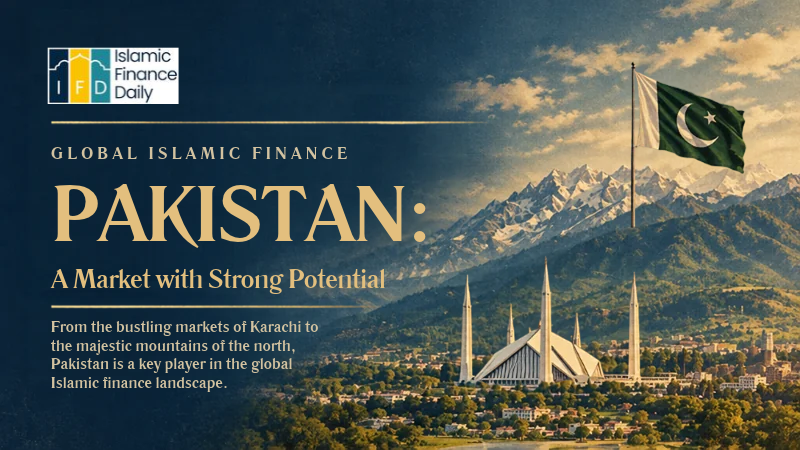
Pakistan has an important and distinctive position in the global Islamic finance industry. Its development is shaped not only by the expansion of Islamic financial institutions and markets but also by a constitutional commitment to eliminate riba from the country’s financial system.
The country’s Islamic finance ecosystem includes Islamic banking, sukuk, Islamic capital markets, takaful, Islamic investment management, financial technology and Shariah-compliant non-bank financial services.
Pakistan has progressively developed its Islamic financial infrastructure through regulatory reforms, institutional initiatives and the establishment of dedicated Islamic finance departments within key financial authorities.
The State Bank of Pakistan (SBP) oversees Islamic banking, while the Securities and Exchange Commission of Pakistan (SECP) regulates Islamic finance activities within the non-bank financial sector, including capital markets, insurance and non-bank financial institutions.
According to the 2026 Islamic Finance Development Indicator (IFDI), published by the Islamic Corporation for the Development of the Private Sector (ICD) in collaboration with London Stock Exchange Group (LSEG), Pakistan ranked fifth among 140 countries assessed.
The country’s development is particularly significant because it is pursuing a broader transformation of its financial system towards Shariah-compliant operations, with a constitutional deadline of 1 January 2028 for the elimination of riba.
2. Historical Development of Islamic Finance in Pakistan
Pakistan’s Islamic finance journey is closely connected to the country’s founding and its constitutional and economic aspirations.
Following independence in 1947, the development of an economic and financial system compatible with Islamic principles became an important national objective.
During his address at the inauguration of the State Bank of Pakistan on 1 July 1948, Pakistan’s founder, Muhammad Ali Jinnah, expressed his vision for developing banking practices compatible with Islamic principles and the country’s social and economic framework.
In the 1950s, the State Bank of Pakistan established an Islamic Economic Division within its Research Department to undertake research on Islamic economic principles.
Further efforts towards the Islamisation of the financial system took place during the 1970s and 1980s. However, the implementation of an entirely interest-free banking system encountered legal, institutional and operational challenges.
A significant development occurred in 2001 when Pakistan adopted a renewed approach to Islamic banking, allowing Islamic and conventional banking to operate alongside one another.
The State Bank of Pakistan introduced a three-pronged strategy:
- Establishment of full-fledged Islamic commercial banks.
- Establishment of Islamic banking subsidiaries by conventional banks.
- Permission for conventional banks to operate dedicated Islamic banking branches.
In 2002, Meezan Bank received Pakistan’s first Islamic commercial banking licence and commenced operations as a scheduled Islamic commercial bank.
Another important milestone was the introduction of sovereign sukuk. Pakistan entered the sovereign sukuk market in 2008, creating an additional instrument for Shariah-compliant government financing.
Over subsequent years, the country expanded its Islamic banking network, developed domestic sukuk markets and introduced regulatory frameworks for Islamic insurance and capital market products.
3. Regulatory and Shariah Governance Framework
Pakistan’s Islamic finance industry operates through a regulatory structure involving the central bank, capital market regulator and Shariah advisory institutions.
State Bank of Pakistan (SBP)
The State Bank of Pakistan is the country’s central bank and the principal regulator of Islamic banking institutions.
Its responsibilities include:
- Licensing and supervising Islamic banks.
- Regulating Islamic banking branches and windows.
- Establishing Shariah governance requirements.
- Developing Islamic money markets.
- Promoting Islamic financial products and services.
- Supporting the transition towards a Shariah-compliant financial system.
SBP has also established a dedicated Islamic Banking Department to support the development and regulation of Islamic banking.
Its Shariah Governance Framework establishes requirements for Islamic banking institutions, including Shariah supervision, internal Shariah audits and compliance arrangements.
The SBP also maintains a Shariah Advisory Committee that provides guidance on Shariah-related matters within its regulatory responsibilities.
Securities and Exchange Commission of Pakistan (SECP)
The Securities and Exchange Commission of Pakistan regulates the country’s corporate sector, insurance industry, non-bank financial institutions and capital markets.
Its Islamic Finance Department supports the development of Shariah-compliant financial products and regulatory arrangements outside the banking sector.
The SECP’s responsibilities include:
- Islamic capital market development.
- Regulation of sukuk structures.
- Shariah-compliant securities.
- Islamic insurance and takaful.
- Islamic investment funds.
- Modaraba companies.
- Shariah governance and standardisation.
In December 2024, the SECP approved its Strategic Action Plan 2024–2026 to facilitate the development of Islamic finance across the non-bank financial sector.
The plan focuses on growth acceleration, standardisation, improved quality and strengthening the legal framework.
Shariah Advisory Framework
Shariah governance is an important part of Pakistan’s Islamic financial system.
SBP and SECP have established their respective Shariah advisory arrangements to support regulatory oversight and Shariah compliance.
Islamic financial institutions are also required to maintain appropriate Shariah governance arrangements, including Shariah boards or advisers, according to the applicable regulatory framework.
Pakistan has also adopted standards issued by international standard-setting bodies.
By December 2025, SBP had adopted 45 AAOIFI Shariah standards and 10 IFSB standards, strengthening the regulatory framework for Islamic banking.
4. Islamic Banking in Pakistan
Islamic banking is the largest and most established component of Pakistan’s Islamic finance industry.
The country operates a dual banking system, allowing full-fledged Islamic banks and Islamic banking branches of conventional banks to operate alongside conventional banking institutions.
Islamic banks provide financial products and services to individuals, businesses, corporations and public sector organisations.
These include:
- Current and savings accounts.
- Home financing.
- Personal and consumer financing.
- Corporate and commercial financing.
- Trade finance.
- Working capital facilities.
- Islamic investment products.
- Treasury and liquidity management services.
Size of the Islamic Banking Industry
According to the State Bank of Pakistan’s Financial Stability Review 2025, Islamic banking institutions recorded the following results at the end of December 2025:
| Indicator | December 2025 |
|---|---|
| Total assets | PKR 14.467 trillion |
| Total deposits | PKR 11.037 trillion |
| Net financing | PKR 5.654 trillion |
| Net investments | PKR 6.605 trillion |
| Share of total banking assets | 22.9% |
| Share of total banking deposits | 27.8% |
| Islamic banking institutions | 22 |
| Islamic banking branches | 7,562 |
During 2025, Islamic banking assets increased by 30.7%, while deposits grew by 39.6%.
The industry comprised six full-fledged Islamic banks and Islamic banking operations of 16 conventional banks.
The branch network expanded to 7,562 branches across 146 districts, representing the highest annual expansion recorded by the sector.
Major Islamic Banking Institutions
Some of the important institutions operating in Pakistan’s Islamic banking market include:
- Meezan Bank Limited.
- Faysal Bank Limited.
- BankIslami Pakistan Limited.
- Dubai Islamic Bank Pakistan Limited.
- MCB Islamic Bank Limited.
- Bank AL Habib Islamic Banking.
- HBL Islamic Banking.
- UBL Ameen.
- Allied Bank Islamic Banking.
- Bank Alfalah Islamic Banking.
These institutions contribute to the expansion of Islamic deposits, financing, investment products and other Shariah-compliant banking services.
5. Sukuk and Islamic Capital Markets
Pakistan’s Islamic capital market has developed through the expansion of sovereign sukuk, corporate sukuk and Shariah-compliant investment products.
Sukuk are an important component of the country’s Islamic financial infrastructure, providing financing opportunities for the government and private sector.
The market includes:
- Government of Pakistan Ijarah Sukuk.
- Corporate sukuk.
- Domestic sovereign sukuk.
- International sovereign sukuk.
- Green sukuk.
- Shariah-compliant listed securities.
- Islamic mutual funds.
Government Sukuk
Pakistan introduced sovereign sukuk in 2008 as an alternative instrument for raising funds in accordance with Shariah principles.
Government of Pakistan Ijarah Sukuk have become particularly important for Islamic banking institutions, providing investment opportunities and supporting liquidity management.
During 2025, the government raised more than PKR 2 trillion through domestic sukuk issuances, marking its highest annual issuance volume since the introduction of sovereign sukuk in 2008.
The issuance programme included different maturities and pricing structures, supporting demand from Islamic banks, conventional financial institutions and other investors.
Pakistan’s First Sovereign Domestic Green Sukuk
A significant development occurred in May 2025 when Pakistan launched its first sovereign domestic green sukuk through the Pakistan Stock Exchange.
The instrument, valued at PKR 30 billion, was oversubscribed 5.4 times.
The issuance represented an important step in connecting Islamic capital markets with sustainable financing.
Shariah-Compliant Securities
Pakistan Stock Exchange (PSX) provides access to Shariah-compliant listed securities and Islamic equity market indices.
Important indices include:
- KMI All Share Index.
- KMI-30 Index.
- Meezan Pakistan Index.
The availability of these indices provides investors with market benchmarks for evaluating Shariah-compliant equity investments.
The SECP also maintains regulatory requirements and registers relating to Shariah-compliant securities and sukuk.
6. Takaful Industry
Takaful is an established component of Pakistan’s Islamic non-bank financial sector.
The industry provides Shariah-compliant protection through arrangements based on mutual assistance, shared responsibility and risk-sharing principles.
Pakistan’s takaful market includes:
- Family takaful.
- General takaful.
- Health-related protection.
- Motor takaful.
- Property and fire takaful.
- Business and corporate protection.
Industry Development
According to the State Bank of Pakistan’s Financial Stability Review 2025, family takaful represented approximately 17% of Pakistan’s life insurance market as of September 2025.
The same report noted that general takaful represented approximately 14% of the non-life insurance segment by 2024.
These figures demonstrate the development of both family and general takaful, although the two segments have different market sizes and reporting periods.
Takaful Operators
Examples of dedicated takaful operators in Pakistan include:
- Pak-Qatar Family Takaful Limited.
- Dawood Family Takaful Limited.
- 5th Pillar Family Takaful Limited.
- Pak-Qatar General Takaful Limited.
- Salaam Takaful Limited.
- Pak Overseas Takaful Company Limited.
The sector also includes conventional insurance companies operating takaful windows under the applicable regulatory framework.
Regulatory Development
The SECP supervises the insurance and takaful sector and has introduced regulatory measures to support its development.
Its initiatives include improvements to takaful regulations, corporate governance, risk management and the broader insurance regulatory framework.
In June 2025, the SECP published a diagnostic study examining the future of takaful in Pakistan, highlighting industry opportunities, structural challenges and possible areas for development.
7. Islamic Investment and Asset Management
Pakistan’s Islamic investment industry provides Shariah-compliant opportunities for individual and institutional investors.
The sector includes:
- Islamic mutual funds.
- Shariah-compliant equity funds.
- Islamic income funds.
- Islamic money market funds.
- Sukuk investment funds.
- Modaraba companies.
- Shariah-compliant investment management products.
The SECP regulates relevant non-bank financial institutions and investment management activities.
Islamic mutual funds provide investors with access to professionally managed portfolios structured according to Shariah requirements.
Pakistan also has an established modaraba sector, which operates under a dedicated regulatory framework.
Modaraba structures are based on Islamic financing and business principles and have historically formed part of the country’s Islamic non-bank financial infrastructure.
The continued development of Islamic asset management is important for expanding investment choices and strengthening the domestic Islamic capital market.
8. Islamic Fintech and Digital Financial Services
Pakistan’s digital financial services industry offers opportunities for the development of Shariah-compliant financial technology.
Islamic fintech can support access to financial services through digital platforms and technology-enabled business models.
Relevant areas include:
- Digital Islamic banking.
- Shariah-compliant financing platforms.
- Digital payments.
- Islamic investment platforms.
- Islamic crowdfunding.
- Technology-enabled takaful.
- Digital financial services for small businesses.
The growth of digital Islamic banking is also supported by the increasing adoption of mobile banking and digital financial services.
An important development during 2025 was the commencement of full-scale Islamic operations by Mashreq Bank Pakistan Limited, a digital bank.
The SECP has also introduced initiatives concerning fintech and non-bank financial services, including its Fintech Framework for the Non-Banking Sector.
However, digital financial services should not automatically be classified as Islamic fintech. Their products, contractual arrangements and Shariah governance must be assessed individually.
The development of Islamic fintech will depend on regulatory clarity, consumer protection, cybersecurity, digital infrastructure and the availability of Shariah-compliant financial products.
9. Islamic Finance Education, Research and Professional Development
Pakistan has developed an academic and professional ecosystem supporting Islamic banking, Islamic economics and Shariah-compliant financial services.
Universities and specialised research centres contribute through academic programmes, professional training, research publications and industry collaboration.
Examples include:
- International Institute of Islamic Economics (IIIE), International Islamic University Islamabad.
- Centre for Excellence in Islamic Finance (CEIF), Institute of Business Administration (IBA), Karachi.
- Centre for Excellence in Islamic Finance, Lahore University of Management Sciences (LUMS).
- Centre for Excellence in Islamic Finance, Institute of Management Sciences (IMSciences), Peshawar.
- International Islamic University Islamabad.
- University of Karachi.
These institutions contribute to the development of professionals and researchers in Islamic banking, Islamic economics, Shariah advisory, Islamic capital markets and related disciplines.
Professional Development
The growth of Pakistan’s Islamic finance industry has increased the importance of specialised professional qualifications and training.
Relevant areas of professional development include:
- Islamic banking operations.
- Shariah governance and compliance.
- Islamic accounting and auditing.
- Islamic capital markets.
- Takaful operations.
- Islamic financial product structuring.
- Risk management.
The State Bank of Pakistan has also undertaken awareness and capacity-building initiatives involving universities, financial institutions, government departments and religious educational institutions.
10. Pakistan’s International Position in Islamic Finance
Pakistan maintains an important position in the global Islamic finance industry.
According to the 2026 ICD–LSEG Islamic Finance Development Indicator, Pakistan ranked fifth globally, with a score of 74.
Its position reflects the development of its Islamic banking industry, sukuk market, regulatory framework and Islamic finance knowledge ecosystem.
Pakistan’s Islamic banking market has also continued to expand, with assets reaching PKR14.467 trillion at the end of December 2025.
The country has further strengthened its international profile through sovereign sukuk issuance, green sukuk development and its participation in international Islamic finance standardisation initiatives.
Pakistan’s experience is particularly relevant to countries examining the development of Islamic banking within a dual financial system and the gradual transformation of conventional financial institutions.
11. Transition Towards a Riba-Free Financial System
One of the most significant developments in Pakistan’s Islamic finance industry is its constitutional commitment to eliminating riba from the financial system.
Federal Shariat Court Judgment 2022
On 28 April 2022, the Federal Shariat Court announced its judgment in the Riba case.
The court declared the prohibition of riba to be complete and absolute under the injunctions of Islam and directed the government to take the necessary steps to eliminate riba from the country’s financial system.
The judgment established 31 December 2027 as the deadline for completing the transition.
Following the judgment, the State Bank of Pakistan and several commercial banks withdrew their appeals against the decision in November 2022.
Constitutional Amendment 2024
A further important development came through the Constitution (Twenty-sixth Amendment) Act, 2024.
The amendment modified Article 38(f) of the Constitution, directing the State to eliminate riba completely before 1 January 2028.
This gave the transition towards a riba-free financial system an explicit constitutional deadline.
State Bank of Pakistan’s Transformation Initiatives
SBP established a high-level Committee for Transformation to support the conversion of conventional banking into Islamic banking.
The committee operates through seven working groups and 36 workstreams or sub-workstreams.
According to SBP’s Financial Stability Review 2025, these groups had conducted more than 500 meetings.
Their work includes:
- Reviewing legal and regulatory frameworks.
- Developing guidance for conventional banks transitioning to Islamic operations.
- Strengthening Shariah governance.
- Building awareness and professional capacity.
- Developing Islamic liquidity management instruments.
- Improving the availability of assets for sukuk issuance.
Government’s Post-2027 Financial Sector Strategy
In 2026, the government also advanced its post-2027 financial sector transition strategy.
The reported policy direction provides for new government financing transactions to be structured through Shariah-compliant modes from 1 January 2028, while existing contractual obligations are to be honoured until maturity.
This distinction is important because the transition involves not only banking institutions but also government borrowing, public debt management, liquidity arrangements and international financing.
The conversion of an entire financial system requires significant institutional, legal, operational and market infrastructure changes.
Consequently, Pakistan’s transition towards a riba-free financial system remains an important ongoing development rather than a completed process.
12. Recent Developments and Future Direction
Pakistan’s Islamic finance development agenda is shaped by several interconnected priorities.
Expansion of Islamic Banking
The continued growth of Islamic banking branches, deposits and financing remains important for increasing the sector’s contribution to the national economy.
Development of Sukuk Markets
Government sukuk issuance and the development of corporate sukuk markets are important for expanding Shariah-compliant financing opportunities.
The availability of different sukuk maturities and structures will also be important for liquidity management during the transition towards a riba-free financial system.
Strengthening Non-Bank Islamic Finance
The SECP’s Strategic Action Plan 2024–2026 seeks to strengthen Islamic finance across the non-bank financial sector.
This includes capital markets, takaful, investment management and other regulated financial services.
Green and Sustainable Sukuk
Pakistan’s first sovereign domestic green sukuk has established an additional pathway for connecting Islamic finance with sustainable development.
The government’s Sovereign Sustainable Finance Framework, introduced in September 2025, also provides a framework for sustainable financing instruments, including international sukuk.
Islamic Finance Education and Professional Capacity
The expansion of Islamic financial services and the transition of conventional institutions require qualified professionals with knowledge of Shariah, banking, accounting, regulation, risk management and financial markets.
Education, research and professional development will therefore remain important components of the country’s long-term Islamic finance strategy.
13. Conclusion
Pakistan has developed a substantial Islamic finance ecosystem through regulatory reforms, institutional development, Islamic banking expansion and the growth of domestic sukuk markets.
Its fifth-place position in the 2026 Islamic Finance Development Indicator reflects its established presence in the international Islamic finance industry.
The country also occupies a distinctive position because of its constitutional commitment to eliminating riba completely before 1 January 2028.
The transition represents a significant undertaking involving banking institutions, capital markets, government financing, insurance, financial regulation and professional capacity development.
As Pakistan continues to expand its Islamic financial infrastructure, its experience provides an important reference for understanding the opportunities and challenges involved in developing a comprehensive Shariah-compliant financial system.
References and Further Reading
- State Bank of Pakistan (SBP) – Financial Stability Review 2025
- State Bank of Pakistan – Islamic Banking in Pakistan: History and Regulatory Framework
- State Bank of Pakistan – Islamic Banking Bulletin
- Securities and Exchange Commission of Pakistan (SECP) – Islamic Finance Bulletin 2025–26
- SECP – Strategic Action Plan 2024–2026 for Islamic Finance
- SECP – Diagnostic Study: Future of Takaful in Pakistan
- National Assembly of Pakistan – Constitution of the Islamic Republic of Pakistan
- Pakistan Stock Exchange – Pakistan’s First Sovereign Domestic Green Sukuk
- Government of Pakistan – Sovereign Sustainable Financing Framework Announcement
- ICD and LSEG – Islamic Finance Development Report 2026
Disclaimer: IslamicFinanceDaily.com publishes this article for informational purposes only. The content is based on publicly available information and official announcements from the referenced institution. IslamicFinanceDaily.com does not provide financial, investment, or legal advice. Readers should verify information with the original source before making any financial or business decisions.