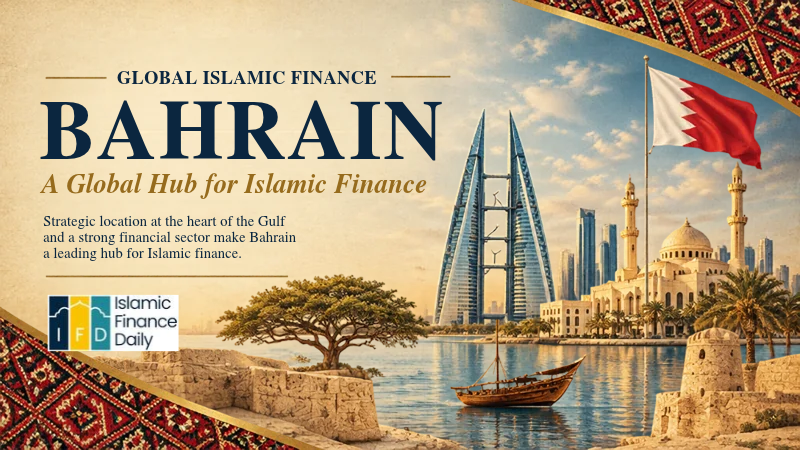
Bahrain Islamic Finance Industry: Complete Overview
1. Introduction
Bahrain is one of the established centres of the global Islamic finance industry. Its development began with the establishment of Bahrain Islamic Bank in 1979, the country’s first Islamic bank and one of the earliest full-fledged Islamic commercial banks in the Gulf region.
Over the following decades, Bahrain developed a broad Islamic financial ecosystem covering Islamic banking, sukuk, takaful, Islamic investment funds, asset management and financial technology.
The Kingdom’s contribution extends beyond its domestic financial institutions. Bahrain is home to important international Islamic finance organisations, including the Accounting and Auditing Organization for Islamic Financial Institutions (AAOIFI) and the International Islamic Financial Market (IIFM). These organisations contribute to the development of standards and financial-market infrastructure used by institutions in different jurisdictions.
The Central Bank of Bahrain (CBB) supervises the country’s financial system through a regulatory framework that accommodates both conventional and Islamic financial institutions.
By the first half of 2026, Bahrain’s Islamic finance industry was estimated by Fitch Ratings at approximately US$94 billion. Islamic banking and sukuk represented the largest components of this market.
This article examines Bahrain’s Islamic finance industry, including its historical development, regulatory framework, Islamic banking sector, sukuk market, takaful, investment activities, fintech ecosystem and international role.
2. Historical Development of Islamic Finance in Bahrain
Bahrain’s modern Islamic finance industry began in 1979 with the establishment of Bahrain Islamic Bank (BisB), the country’s first Islamic bank.
The establishment of the bank marked an important step in the development of formal Shariah-compliant banking in the Gulf region.
During the following decade, the industry expanded beyond banking. Takaful International began operations in 1989, introducing Islamic insurance services to the Bahraini market.
Another important development took place in 1991, when the Accounting and Auditing Organization for Islamic Financial Institutions (AAOIFI) was established in Bahrain.
AAOIFI was created to develop accounting, auditing, Shariah, ethics and governance standards for Islamic financial institutions. Its establishment strengthened Bahrain’s position as a centre for Islamic finance standard-setting.
The development of professional education also contributed to the sector. The Bahrain Institute of Banking and Finance (BIBF), established in 1981, subsequently developed specialised Islamic finance education and professional training.
In 2002, the International Islamic Financial Market (IIFM) was established under a Royal Decree in Bahrain. The organisation focuses on standardising Shariah-compliant financial contracts and product documentation, particularly in Islamic capital markets and liquidity management.
Over time, Bahrain expanded its Islamic banking regulations, sukuk market and takaful framework. The Central Bank of Bahrain also introduced regulatory requirements covering Shariah governance, Islamic investment products and liquidity-management arrangements.
Today, Bahrain’s Islamic finance industry combines domestic financial institutions with international organisations that contribute to the development of Islamic finance standards and market practices.
References: Bahrain Islamic Bank; AAOIFI; IIFM; Bahrain Institute of Banking and Finance; IMF.
3. Regulatory and Shariah Governance Framework
Bahrain operates a dual financial system in which Islamic and conventional financial institutions operate under a common regulatory authority.
The Central Bank of Bahrain is responsible for licensing, regulating and supervising the country’s financial services industry.
Since 2002, the CBB has functioned as the single regulator for Bahrain’s financial system.
Central Bank of Bahrain
The CBB Rulebook provides the principal regulatory framework for financial institutions operating in Bahrain.
Volume 2 of the Rulebook covers Islamic banks, while other volumes address different categories of financial institutions and regulated activities.
The Islamic banking regulatory framework covers areas including:
- Licensing and authorisation
- Capital adequacy
- Risk management
- Liquidity management
- Corporate governance
- Financial reporting
- Internal controls
- Shariah governance
- Conduct of business
- Regulatory disclosures
The framework is designed to accommodate the specific operational and contractual characteristics of Islamic financial institutions.
Shariah governance
Bahrain has developed a structured regulatory approach to Shariah governance.
The CBB’s Shariah Governance Module establishes requirements for Islamic banks, including the role of Shariah supervisory boards, internal Shariah coordination and implementation, internal Shariah audit and independent external Shariah compliance audit.
The regulatory framework also gives importance to AAOIFI Shariah standards.
The CBB established a Centralised Shariah Supervisory Board in 2016, adding a national-level advisory and supervisory element to the country’s Islamic finance framework.
AAOIFI standards
AAOIFI is headquartered in Bahrain and develops standards covering:
- Shariah
- Accounting
- Auditing
- Ethics
- Governance
Its standards are adopted, recognised or used as references by regulatory authorities and financial institutions in different countries.
Bahrain’s regulatory environment has helped establish a close relationship between domestic Islamic banking supervision and international Islamic finance standard-setting.
International Islamic Financial Market
The International Islamic Financial Market was established in Bahrain in 2002.
IIFM develops standardised documentation and contractual frameworks for Islamic financial transactions, including:
- Sukuk
- Islamic hedging
- Liquidity management
- Treasury transactions
- Interbank placements
- Trade finance
Its work supports the development of standardised Islamic financial-market practices across jurisdictions.
References: Central Bank of Bahrain Rulebook; AAOIFI; IIFM; IMF.
4. Islamic Banking in Bahrain
Islamic banking is the largest segment of Bahrain’s Islamic finance industry.
The country has a well-established Islamic banking market consisting of retail and wholesale banks, as well as conventional banks that provide Shariah-compliant products through Islamic windows.
Structure of the Islamic banking sector
Bahrain’s Islamic banking sector serves both domestic and international financial markets.
According to S&P Global Ratings, Bahrain had nine active Islamic banks as of March 2026:
- Six Islamic retail banks
- Three Islamic wholesale banks
Several conventional retail banks also provide Islamic banking products and services.
S&P reported that Islamic retail banks held total assets of approximately US$70.3 billion as of 31 March 2026, representing around 70% of the country’s retail banking assets.
The figures illustrate the importance of Islamic banking within Bahrain’s domestic retail banking market.
Major Islamic banking institutions
Examples of Islamic banking institutions operating in Bahrain include:
- Bahrain Islamic Bank
- Al Salam Bank
- Khaleeji Bank
- Kuwait Finance House – Bahrain
- Bank ABC Islamic
- Ithmaar Bank
These institutions operate across different areas of Islamic banking, including retail banking, corporate financing, investment and wholesale financial services.
Their individual business models and regulatory classifications differ, so the list should not be interpreted as a ranking of institutions.
Islamic banking products
Islamic banks in Bahrain provide financial products based on recognised Shariah contracts.
Murabaha
Murabaha is a cost-plus sale arrangement in which the bank purchases an asset and sells it to the customer at an agreed price that includes a disclosed profit margin.
Mudaraba
Mudaraba is a partnership in which one party provides capital and another provides management or entrepreneurial expertise. Profits are distributed according to an agreed ratio, while financial losses are generally borne by the capital provider, subject to the applicable rules.
Musharaka
Musharaka is a partnership arrangement in which the parties contribute capital and share profits according to an agreed arrangement. Financial losses are generally allocated according to capital contributions.
Ijarah
Ijarah is a leasing arrangement under which a financial institution provides the use of an asset in exchange for rental payments.
Wakala
Wakala is an agency arrangement in which one party appoints another to act on its behalf for an agreed purpose.
Salam and Istisna
Salam and Istisna are contracts used in financing arrangements involving future delivery of goods, agricultural production, manufacturing and construction.
Islamic banking consolidation
Bahrain’s banking sector has experienced a period of consolidation.
One notable transaction was Kuwait Finance House’s acquisition of Ahli United Bank in 2024. The transaction changed the structure of the wider banking market and brought a major conventional banking institution into the Kuwait Finance House group.
The consolidation of financial institutions has also been relevant to the Islamic banking sector, as institutions seek to strengthen their market position, operational efficiency and competitiveness.
The development of Islamic banking in Bahrain therefore involves both expansion of Shariah-compliant financial services and changes in the structure of existing banking institutions.
References: S&P Global Ratings, July 2026; Central Bank of Bahrain; Bahrain Islamic Bank; Al Salam Bank; Kuwait Finance House.
5. Islamic Wholesale Banking and International Financial Services
Bahrain has an established wholesale banking sector that serves regional and international clients.
Islamic wholesale banks provide financial services to corporations, financial institutions, investment entities and other institutional customers.
Their activities may include:
- Corporate and institutional financing
- Trade finance
- Islamic treasury services
- Sukuk investment
- Investment banking
- Asset management
- Structured Islamic financing
- Interbank liquidity arrangements
The presence of international financial institutions and Islamic finance infrastructure organisations has supported Bahrain’s role in cross-border Islamic financial services.
Islamic wholesale banking is particularly relevant to Bahrain because the country’s financial sector has historically served clients beyond its domestic market.
The sector also provides a connection between Islamic banking, sukuk markets, investment management and international liquidity arrangements.
6. Sukuk and Islamic Capital Markets
Bahrain is an established participant in the international sukuk market.
The country has developed sovereign sukuk programmes and regulatory arrangements that support the issuance, listing and trading of Shariah-compliant securities.
The Central Bank of Bahrain issues government sukuk on behalf of the Government of Bahrain.
Sovereign sukuk programme
Bahrain’s sovereign sukuk programme includes short-term and long-term instruments.
The main structures include:
- Ijarah Sukuk
- Ijara Murabaha Sukuk
These instruments provide Shariah-compliant investment opportunities and support the government’s financing requirements.
Short-term sukuk
The CBB regularly issues short-term Ijara Murabaha Sukuk.
For example, on 27 October 2026, the CBB announced that its six-month short-term Ijara Murabaha Sukuk issue of BHD 50 million had received subscriptions of BHD 54.712 million, representing an oversubscription of 109%.
The issue carried a maturity period of 182 days and was scheduled to begin on 29 October 2026.
The regular issuance programme provides eligible investors and financial institutions with access to short-term Shariah-compliant securities.
Longer-term government sukuk
Bahrain also issues longer-term Islamic securities.
In August 2025, the CBB issued a BHD 200 million Islamic Ijara Murabaha Sukuk on behalf of the government.
The four-year securities carried an annual fixed return of 5.75% and were listed through Bahrain Bourse.
Sukuk market development
Fitch estimated that Bahrain’s outstanding sukuk exceeded US$20 billion in the first half of 2026, representing annual growth of approximately 16%.
Sukuk accounted for around 37% of Bahrain’s debt capital market at the end of the first half of 2026, compared with 35% a year earlier.
These figures demonstrate the importance of sukuk within Bahrain’s Islamic finance industry and its wider debt capital market.
Liquidity management
Sukuk also play an important role in Islamic banking liquidity management.
The CBB has introduced Shariah-compliant liquidity facilities for Islamic retail banks, including arrangements that allow eligible sukuk to be used within liquidity-management operations.
The CBB’s Wakalah Facility and Commodity Murabaha Facility provide additional mechanisms for managing liquidity in the Islamic banking sector.
References: Central Bank of Bahrain; Bahrain Bourse; Fitch Ratings, July 2026; CBB Annual Report 2024.
7. Takaful and Islamic Insurance
Takaful is an established component of Bahrain’s Islamic financial-services industry.
The country has developed a regulated Islamic insurance market alongside its conventional insurance sector.
Takaful International began operations in 1989 and is recognised as one of the early takaful operators in the region.
Takaful market structure
Takaful companies provide Shariah-compliant insurance services through arrangements based on mutual assistance and shared responsibility.
Participants contribute to a common fund, which is used to meet eligible claims in accordance with the applicable takaful structure.
Takaful products in Bahrain cover several insurance categories, including:
- Motor
- Medical
- Property
- Engineering
- Marine
- Family and long-term protection
- General insurance
The Central Bank of Bahrain regulates insurance and takaful firms under its insurance regulatory framework.
Takaful market figures
The CBB’s March 2025 Financial Stability Report reported that gross premiums for takaful companies increased from BHD 64.4 million in September 2023 to BHD 69.3 million in September 2024.
This represented year-on-year growth of 7.6%.
Net premiums written increased from BHD 39.1 million to BHD 43.2 million over the same period.
Medical and motor insurance represented the largest components of takaful business.
The figures illustrate the presence of an established takaful market, although they relate to September 2024 and should not be presented as 2026 market totals.
Reinsurance and retakaful
Retakaful provides Shariah-compliant risk-sharing arrangements for takaful operators.
It supports the management of larger risks and allows takaful companies to distribute exposures across other eligible institutions.
The development of takaful and retakaful services contributes to Bahrain’s wider Islamic financial-services ecosystem.
References: Central Bank of Bahrain, Financial Stability Report, March 2025; Central Bank of Bahrain, Insurance Market Review; Takaful International.
8. Islamic Investment and Asset Management
Islamic investment and asset management form an important part of Bahrain’s financial sector.
The country is home to a broad range of investment firms, fund managers and financial institutions offering Shariah-compliant investment products.
These activities include Islamic collective investment undertakings, sukuk funds, Islamic equity investments and other Shariah-compliant investment structures.
Islamic collective investment undertakings
Islamic collective investment undertakings (CIUs) allow investors to participate in pooled investment structures managed according to Shariah principles.
Their investment activities may include:
- Sukuk
- Shariah-compliant equities
- Islamic money-market instruments
- Real estate
- Other permissible investment assets
Fitch reported that the net asset value of Bahrain’s Shariah-compliant collective investment undertakings reached approximately US$2.5 billion at the end of March 2026, representing year-on-year growth of 24.5%.
This demonstrates the contribution of Islamic investment funds to the country’s wider Islamic finance market.
Islamic asset management
Bahrain’s financial ecosystem includes institutions involved in Islamic investment management, private equity, investment banking and alternative investments.
GFH Financial Group is one example of a Bahrain-based financial group with activities across investment management, commercial banking and Islamic financial services.
Islamic asset management provides opportunities to diversify the country’s financial industry beyond traditional banking and sovereign sukuk.
The continued development of this segment depends on investment opportunities, market infrastructure, regulatory supervision and investor demand.
References: Central Bank of Bahrain; Fitch Ratings, July 2026; Bahrain Bourse.
9. Islamic Fintech and Digital Financial Services
Bahrain has developed a regulatory and business environment that supports financial technology and digital financial services.
The Central Bank of Bahrain introduced its FinTech Regulatory Sandbox in 2017, allowing eligible companies to test innovative financial products and services under regulatory supervision.
The initiative supports the development of new financial technologies while providing a controlled environment for testing and regulatory engagement.
Regulatory Sandbox
The CBB Regulatory Sandbox is available to eligible financial technology businesses seeking to test innovative solutions.
The framework supports experimentation in areas such as:
- Digital payments
- Open banking
- Financial applications
- Digital financial services
- Technology-enabled banking
- New financial business models
Islamic fintech opportunities
The growth of digital financial services creates opportunities for Shariah-compliant financial products.
Potential areas include:
- Digital Islamic banking
- Mobile Murabaha financing
- Digital investment platforms
- Islamic crowdfunding
- Automated Shariah compliance tools
- Digital sukuk distribution
- Islamic wealth management
- Technology-supported takaful services
Bahrain Islamic Bank has also introduced digital initiatives supporting its Islamic banking services.
In November 2025, the bank launched Al Murshid, an artificial-intelligence-powered Shariah advisory platform.
Such initiatives illustrate how technology can support customer access to Islamic financial information and services.
Bahrain’s established financial infrastructure, regulatory sandbox and Islamic banking market provide an environment for further development of Islamic fintech.
However, individual fintech products should only be classified as Islamic fintech where their underlying financial structures and operations are demonstrably Shariah-compliant.
References: Bahrain Government – Financial Technology; Central Bank of Bahrain; Bahrain Islamic Bank.
10. Islamic Social Finance and Waqf
Islamic social finance is another area connected to Bahrain’s wider Islamic finance ecosystem.
It includes instruments and institutions based on charitable contributions, social responsibility and community development.
Important instruments include:
- Zakat
- Sadaqah
- Waqf
- Qard Hasan
- Other charitable financing arrangements
Waqf has historical significance in Islamic societies and can support education, healthcare, religious institutions and community development.
Bahrain’s Islamic financial institutions and charitable organisations operate within a wider environment that includes Islamic social and community initiatives.
The integration of social finance with formal Islamic banking and investment services offers opportunities for further development.
Potential areas include structured Waqf investment, digital Zakat services and the use of Qard Hasan for community-focused financing.
These activities should be distinguished from commercial Islamic banking because their purposes, governance arrangements and financial structures are different.
11. Islamic Finance Education, Research and Professional Development
Bahrain has an established Islamic finance education and professional training ecosystem.
Its contribution to the industry extends beyond domestic banking because the country hosts organisations involved in international standard-setting, professional qualifications and financial-market development.
Bahrain Institute of Banking and Finance
The Bahrain Institute of Banking and Finance was established in 1981 and provides education and professional development across banking, finance, insurance, Islamic finance and other business disciplines.
Its Islamic finance activities include specialised courses, professional training and programmes developed in collaboration with international institutions.
BIBF has contributed to the development of Islamic finance professionals in Bahrain and other markets.
AAOIFI qualifications and standards
AAOIFI develops international standards covering Shariah, accounting, auditing, ethics and governance.
Its work also supports professional education and the development of technical expertise among Islamic finance practitioners.
Relevant professional development areas include:
- Islamic banking operations
- Shariah governance
- Islamic accounting
- Islamic auditing
- Sukuk structuring
- Takaful
- Islamic investment management
- Risk management
Research and international collaboration
Bahrain’s Islamic finance ecosystem benefits from cooperation between universities, financial institutions, regulators and international organisations.
AAOIFI and IIFM contribute to research, standardisation and technical discussions relevant to the development of Islamic financial markets.
This institutional environment supports Bahrain’s position as a centre for Islamic finance knowledge and professional development.
References: BIBF; AAOIFI; IIFM.
12. Bahrain’s International Position in Islamic Finance
Bahrain has an important position in the global Islamic finance industry because of its established financial institutions, regulatory framework and international Islamic finance organisations.
The country’s contribution is not limited to the size of its domestic Islamic banking market. It also includes the development of standards, financial contracts, professional education and market infrastructure.
International Islamic finance organisations
Two organisations are particularly relevant to Bahrain’s international role.
Accounting and Auditing Organization for Islamic Financial Institutions (AAOIFI)
Established in 1991 and headquartered in Bahrain, AAOIFI develops international standards covering Shariah, accounting, auditing, ethics and governance.
Its standards are used by regulators and financial institutions across multiple jurisdictions.
International Islamic Financial Market (IIFM)
Established in 2002 and based in Bahrain, IIFM focuses on standardisation of Shariah-compliant financial contracts and product documentation.
Its work covers areas including sukuk, liquidity management and Islamic treasury transactions.
Islamic Finance Development Indicator
The ICD–LSEG Islamic Finance Development Indicator assesses the development of Islamic finance across countries through several dimensions, including:
- Financial performance
- Governance
- Knowledge
- Sustainability
- Awareness
Bahrain was included among the countries completing the leading group in the 2025 IFDI report.
Its international standing reflects the presence of a developed Islamic finance ecosystem, including banking, sukuk, takaful, professional education and international infrastructure organisations.
A specific numerical position or score should be taken from the relevant report’s country-level data rather than inferred from its inclusion among the leading markets.
Regional financial hub
Bahrain’s financial sector includes a large number of licensed financial institutions and has a strong presence in wholesale banking, insurance and investment management.
The Kingdom’s regulatory framework and international financial connections have helped attract financial institutions from the Gulf region and other international markets.
Its Islamic finance infrastructure makes Bahrain an important location for institutions involved in the development of Shariah-compliant financial products and services.
References: AAOIFI; IIFM; Bahrain Government; ICD–LSEG Islamic Finance Development Report 2025.
13. Recent Developments and Future Direction
Bahrain’s Islamic finance industry continues to develop through banking consolidation, sovereign sukuk issuance, digital financial services and the expansion of Islamic investment products.
Several developments are particularly relevant to its future direction.
Growth in Islamic finance assets
Fitch estimated Bahrain’s total Islamic finance industry at approximately US$94 billion at the end of the first half of 2026.
The estimate included Islamic banking, sukuk, Shariah-compliant collective investment undertakings and takaful.
Fitch also forecast that the industry could exceed US$100 billion by 2027. This is a forecast rather than a confirmed future market value.
Continued sovereign sukuk issuance
The government continues to use sukuk as a financing instrument.
Regular short-term Ijara Murabaha Sukuk issuance provides Shariah-compliant investment opportunities and supports liquidity management in the domestic financial market.
The growth of outstanding sukuk also contributes to the development of Bahrain’s debt capital market.
Banking consolidation
The consolidation of financial institutions is an important feature of Bahrain’s banking market.
Changes in ownership, mergers and the restructuring of financial groups may influence the future organisation of Islamic banking.
The development of larger institutions may also affect the range of products, operational efficiency and regional competitiveness.
Digital financial services
The CBB’s regulatory sandbox and the country’s established banking infrastructure provide opportunities for further innovation.
Digital Islamic banking, AI-supported services, digital investment products and technology-enabled Shariah governance are areas to monitor.
Islamic investment and asset management
The growth of Shariah-compliant collective investment undertakings demonstrates the contribution of non-bank financial services to Bahrain’s Islamic finance market.
Further expansion of Islamic investment products could diversify the industry beyond banking and sovereign sukuk.
Professional education and international standard-setting
AAOIFI, IIFM and BIBF continue to provide an institutional foundation for professional development and the wider development of Islamic finance standards.
Their activities are relevant not only to Bahrain but also to the international Islamic finance industry.
Overall, Bahrain’s future development will depend on continued regulatory adaptation, institutional competitiveness, innovation and the expansion of Shariah-compliant financial products across different market segments.
14. Conclusion
Bahrain has developed one of the established Islamic finance ecosystems in the Gulf region.
Since the establishment of Bahrain Islamic Bank in 1979, the country has expanded its Islamic financial industry to include retail and wholesale banking, sukuk, takaful, Islamic investment funds and digital financial services.
Its international contribution is particularly significant. AAOIFI and IIFM are headquartered in Bahrain and support the development of standards and financial-market infrastructure used across the global Islamic finance industry.
The Central Bank of Bahrain provides a regulatory framework for Islamic and conventional financial institutions, while BIBF supports education and professional development.
The country’s Islamic finance market also benefits from an active sovereign sukuk programme and a developed takaful sector.
Bahrain’s future progress will depend on maintaining its regulatory framework, supporting financial innovation, strengthening institutional competitiveness and continuing to contribute to the international development of Islamic finance.
References and Further Reading
- Central Bank of Bahrain – Rulebook
- Central Bank of Bahrain – Annual Reports
- Central Bank of Bahrain – Financial Stability Report, March 2025
- Central Bank of Bahrain – Insurance Market Review
- Bahrain Government – Banking and Finance
- Bahrain Government – Financial Technology
- Bahrain Islamic Bank – About Us
- AAOIFI – About the Organisation
- International Islamic Financial Market – Corporate Profile
- Bahrain Institute of Banking and Finance – About
- Bahrain Bourse – Islamic Ijara Murabaha Sukuk Issue 2, August 2025
- S&P Global Ratings – Islamic Banking in Bahrain: Consolidation Brings Efficiency, July 2026
- Fitch Ratings – Bahrain Islamic Finance Industry Outlook, July 2026
- ICD–LSEG – Islamic Finance Development Report 2025
- International Monetary Fund – Ensuring Financial Stability in Countries with Islamic Banking: Bahrain Case Study
DISCLAIMER
IslamicFinanceDaily.com publishes this article for informational purposes only. The content is based on publicly available information and official announcements from the referenced institution. IslamicFinanceDaily.com does not provide financial, investment, or legal advice. Readers should verify information with the original source before making any financial or business decisions.