The Halal Tokenized Webinar Series 2026 is a seven-week online program hosted by Al Mabrook Financial from 28 June to 9 August 2026. The series explores tokenization, digital assets, blockchain, digital Sukuk, stablecoins, and Shariah-compliant financial innovation. Participants will gain practical insights through expert presentations, real-world case studies, and interactive Q&A sessions.
CIBAFI’s 26th Annual General Meeting will be held virtually on 30 June 2026. The event brings together members and stakeholders from across the Islamic financial services industry to review organizational activities, discuss strategic priorities, and exchange perspectives on developments shaping the future of Islamic finance. The AGM serves as an important platform for collaboration and industry engagement.
The AI Fiqh Literacy for Islamic Research Writing workshop explores the ethical use of artificial intelligence in Islamic research and academic writing. Led by Dr. Sakinah Binti Abdul Samad, the session provides practical guidance on integrating AI tools while adhering to Shariah principles and maintaining academic integrity. The workshop is open to all students, with a particular focus on postgraduate researchers.
AlHuda CIBE-UAE is hosting a live webinar on 4 July 2026 exploring the future of Takaful and Re-Takaful. Featuring international experts from the UAE, Ethiopia, and South Africa, the session will examine global market opportunities, regulatory developments, emerging trends, and practical strategies to help professionals prepare for the evolving Islamic insurance industry.
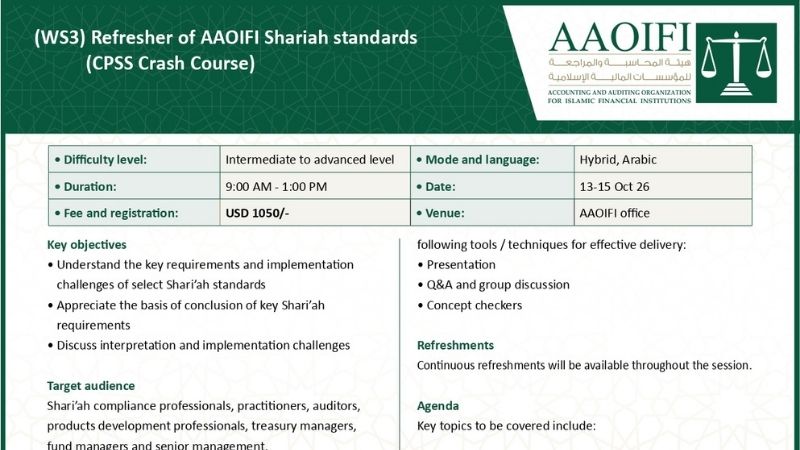
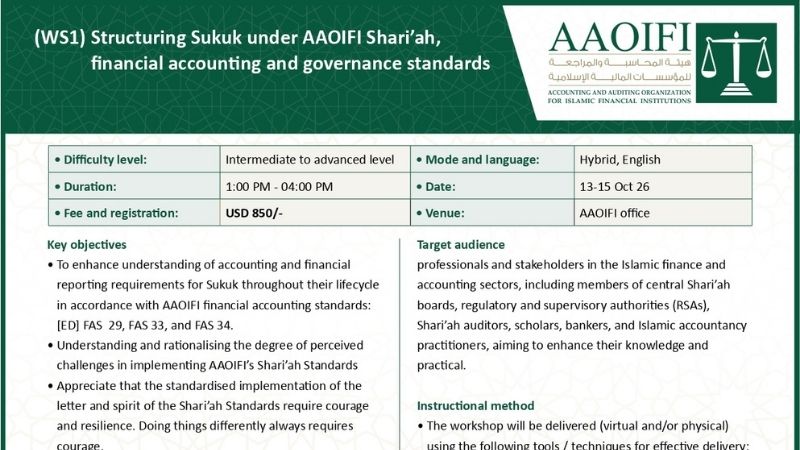
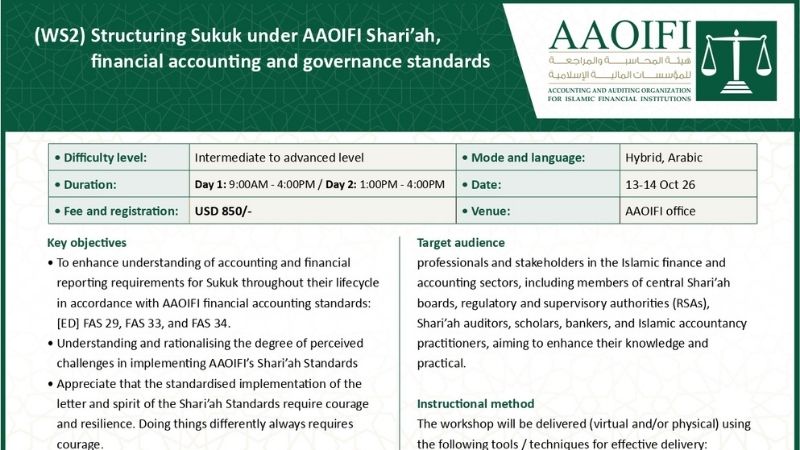
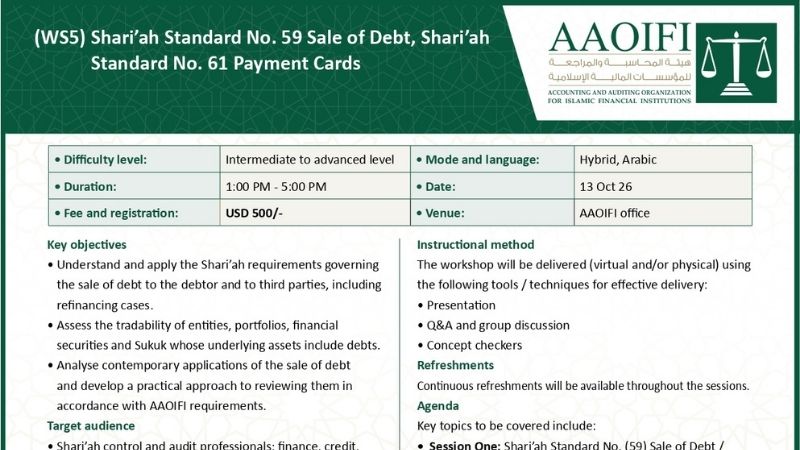
AAOIFI's Crash Course on Shari'ah Standards is a three-day online professional workshop designed for Islamic finance practitioners, Shari'ah scholars, auditors, compliance officers, regulators, and certification candidates. The programme covers AAOIFI Shari'ah Standards related to finance, investment, capital markets, and banking services while providing practical implementation guidance, compliance insights, and preparation for AAOIFI certification programmes including CSAA, CPSSA, CIPA, and CIFP.
The General Council of Islamic Banks and Financial Institutions, in collaboration with the World Federation of Islamic Takaful and Insurance Companies, is hosting a virtual seminar on 6 July 2026. The session explores the evolving role of Takaful in addressing global risks, including governance, innovation, sustainability, and regulatory trends within the Islamic insurance sector. The webinar will be conducted online in Arabic.
Explore the growing role of Sukuk in advancing sustainable and ethical finance at this live webinar hosted by AlHuda CIBE-UAE. Featuring Mr. Suharianto from Indonesia’s Ministry of Finance, the session will examine global Islamic capital market developments, financial inclusion, and emerging opportunities for investors, banking professionals, and Islamic finance practitioners.
Join industry leaders at Rizq Investment Festival 2026 for a panel exploring the future of takaful, Islamic wealth planning, and financial innovation. Featuring Sharene Lee and Sainava Bee Bee, the discussion examines how technology, regulation, and community-driven solutions are shaping the next generation of Shariah-compliant financial protection.
Join the free online Understanding Halal webinar to learn about the Islamic foundations of Halal, contemporary industry challenges, and the business value of Halal certification. Featuring expert speakers, the programme covers Halal standards, certification processes, compliance requirements, and concludes with an interactive Q&A session for participants.
The D-8 Cultural Festival will host a discussion on women’s role in the halal economy on 12 July 2026 in Jakarta, Indonesia. Featuring Dr. Syifa Fauzia, the session will explore how women contribute to innovation, inclusion, entrepreneurship, and sustainable growth. The event offers an opportunity for professionals, entrepreneurs, and future leaders to exchange ideas and explore the role of women in strengthening the wider halal economic ecosystem.
The Workshop on Pool Management & Profit Distribution Framework in Islamic Financial Institutions (IFIs), organized by Al-Sadiq (A.S.) Institute of Islamic Banking, Finance & Takaful, provides practical training on Mudarabah-based investment pools, profit calculation, allocation, distribution mechanisms, regulatory requirements, and Shariah-compliant banking practices. The hybrid programme includes practical exercises, industry case studies, and certificates for participants.
CIBAFI's Online Technical Workshop on Shariah Governance in Islamic Financial Institutions (IFIs) is a two-day programme designed for Islamic finance professionals seeking practical knowledge of Shariah governance frameworks, AAOIFI and IFSB standards, internal Shariah review, audit, and risk management. Participants will gain practical insights through expert-led sessions, industry case studies, and experience sharing.
The 4th Nadwah of Shariah Advisers in Islamic Capital Market 2026 is a key industry forum focusing on aligning Islamic capital market products with Maqasid al-Shariah principles. It brings together Shariah advisers, regulators, scholars, and practitioners to discuss governance, emerging trends, and practical implementation in Islamic finance. Registration closes on 3 July 2026.
AlHuda Centre of Islamic Banking and Economics (AlHuda CIBE) is hosting a live webinar on "Shariah Governance Frameworks: Roles of Boards, Management, and Auditors." The session will provide practical insights into governance structures, compliance, accountability, and risk management within Islamic financial institutions. Industry experts will discuss the responsibilities of Boards, Management, and Auditors in building a resilient Islamic finance industry.
AAOIFI, in collaboration with the Egyptian Islamic Finance Association (EiFA), will hold an Arabic-language online public hearing on 15 July 2026. The session will gather stakeholder feedback on an exposure draft concerning the assessment of necessity for Takaful institutions to obtain conventional reinsurance. Questions, recommendations, comments, and suggestions will contribute to the standard-development process before the final standard is issued.
Join the Institute of Islamic Economics & Finance (IIEF) for an online webinar examining the opportunities and challenges facing Islamic finance in The Gambia. The session will explore Islamic banking growth, Sukuk, Shariah governance, liquidity management, investment opportunities, and financial inclusion, providing valuable insights for finance professionals, policymakers, researchers, and students.
The Waqf: Halal Donor-Advised Funds – A Legacy of Giving webinar explores how Muslims can establish a lasting charitable legacy through Waqf and Halal Donor-Advised Funds. Hosted by Private Wealth Management and Assad Wealth Management, the session covers the history of Waqf, the role of Halal DAFs, tax-efficient charitable giving, and practical approaches to Shariah-compliant wealth and legacy planning.
A professional, hands-on workshop will be held on 18 July 2026 in Karachi, with an option to participate online via Zoom. The programme focuses on Islamic product development, particularly Shariah-compliant bill discounting solutions. Participants will gain practical insights into trade finance structuring, pricing methodologies, risk management, and alternative Islamic financing models through expert-led sessions and real-world case studies.
The Centre for Islamic Business & Finance (CIBF), Institute of Business Management (IoBM), in collaboration with Mutabar (HK) Ltd., is offering the Certified Islamic Banking Practitioner (CIBP) Program. Delivered in a hybrid format, this executive certification provides practical training in Islamic banking, treasury, capital markets, Shariah governance, and banking transformation. The program runs from 18 July to 5 September 2026 and offers scholarships and group discounts for eligible participants.
Join AMEFI’s international webinar exploring the current landscape of Islamic banking in the WAEMU region. The session will examine regulatory developments, governance challenges, compliance, risk management, and future growth opportunities. Led by Islamic finance expert Ahmed Sidi Ibrahim Mazou, the webinar provides valuable insights for professionals, regulators, academics, and students interested in the advancement of Islamic finance across West Africa.
The webinar “Islamic Banking Landscape in the Philippines: Growth, Regulations & the Road Ahead” will explore the development and future direction of Islamic banking in the country. Featuring Ms. Joanne T. Cortez of the Islamic Banking Supervision Group at Bangko Sentral ng Pilipinas, the session will provide insights into sector growth, regulation, and Islamic banking supervision.
The Islamic Finance Capacity and Advisory Bureau (IFCAB) is accepting grant applications for the fifth batch of its eight-week live online Islamic Finance Qualification training programme. Running from 19 July to 6 September 2026, the programme provides structured IFQ syllabus preparation, industry insights, guest sessions, and access to recordings. Full and partial grants are available, with applications closing on 15 July 2026.
MUZAKARAH 2026 will be held on 21–22 July 2026 in Kota Kinabalu, Sabah, Malaysia. The international conference will convene scholars, regulators, researchers, and industry professionals to discuss Shariah compliance, governance, and emerging developments in the Islamic financial system while promoting knowledge exchange and collaboration across the global Islamic finance industry.
The Halal Competency Training programme offers practical online training for professionals responsible for halal compliance and management. Covering halal requirements, management practices, industry standards, and key ingredients, the programme is designed for halal committee members, management, quality teams, and production personnel. Multiple training sessions are available between July and November 2026, with HRD Corp claimable status.
Industry Connect Live Webinar 2026 brings together Islamic finance professionals, academics, and students to explore the relationship between governance, integrity, and sustainable financial development. Led by Datuk Dr. Haji Mazlan, the webinar examines ethical leadership, corruption risks, Islamic social finance, waqf innovation, and the use of emerging technologies to strengthen transparency and accountability.
This free live webinar on 22 July 2026 will explore Islamic capital markets and the principles and methodologies used in Shari'ah screening. Featuring Dr. Shariq Nisar, the session will cover practical industry applications, key challenges, emerging trends, and a live Q&A. The English-language webinar will be hosted online via Zoom at 2:00 PM UAE Time (GMT+4).
This webinar on 22 July 2026 will examine the revised KMI Shariah Screening Criteria, including Shariah governance amendments, KMI Index changes, screening methodology, compliance requirements, and implementation timelines. The session will also explore the impact of the revised framework on listed companies and the capital market, with participation from organisations including PSX, SECP, Al Meezan Investment Management Limited, and Meezan Bank Limited.
AlHuda Centre of Islamic Banking and Economics (AlHuda CIBE – UAE) will host a two-day executive training programme in Dhaka, Bangladesh, on 22–23 July 2026. The programme focuses on Islamic Banking, Islamic Microfinance, Takaful, Sukuk, and Digital Financial Solutions through practical sessions, case studies, and industry best practices. Participants who successfully complete the programme will receive a Certificate of Participation.
AlHuda CIBE - UAE is hosting a two-day online training programme on the operational and practical aspects of Islamic banking, takaful, and Islamic microfinance on 24–25 July 2026. Delivered via Zoom, the programme is designed for bankers, takaful practitioners, regulators, microfinance professionals, and students seeking practical knowledge and industry-focused learning.
The IIiBF Special Talk 2026 explores the evolution of MYOR-i and Shariah-compliant pricing mechanisms within Islamic banking. Led by industry expert Azahari Abdul Kudus, the session will provide participants with practical insights into Islamic pricing benchmarks, current industry developments, and the future of Shariah-compliant financial practices.
INCEIF University and ISRA Associates will host an exclusive industry roundtable on 27 July 2026 examining the implementation of Malaysia's Consumer Credit Act 2025 from an Islamic finance perspective. The discussion will cover governance, Shariah operationalisation, implementation challenges, and industry practices for Islamic consumer credit providers. Participation is limited and subject to confirmation.
The Bahrain Institute of Banking and Finance (BIBF) will host a virtual BIBF-IFT Talk on 29 July 2026 exploring resilience and stability mechanisms in Islamic banking. Presented by Dr. Ronald Rulindo, the session will discuss approaches to strengthening Islamic financial institutions and enhancing financial stability within the industry.
Personal Finance for Muslim Professionals is an in-person community event hosted by MINT that explores practical approaches to managing money in line with Islamic values. Through expert talks, interactive discussions, and networking opportunities, participants will gain valuable insights into halal financial planning, investing, and personal wealth management.
IBFIM will host an online webinar on 30 July 2026 exploring the role of hibah in Islamic estate and legacy planning. Featuring Tuan Haji Aziz Peru, the session will cover the fundamentals and rules of hibah, its advantages, challenges in Muslim inheritance, and important considerations before entering into a hibah arrangement. The webinar offers three CPD hours awarded by the Malaysian Takaful Association.
ICRIE at Minhaj University Lahore is offering a four-week online Professional Certificate in Islamic Banking Products and Operations starting on 1 August 2026. Across eight sessions, participants will explore Islamic banking products, operational processes, documentation, Shari’ah compliance, product risks, and market practices, including Murabaha, Ijarah, Diminishing Musharakah, Salam, and Istisna. The program is designed for students, graduates, bankers, Shari’ah compliance trainees, and researchers.