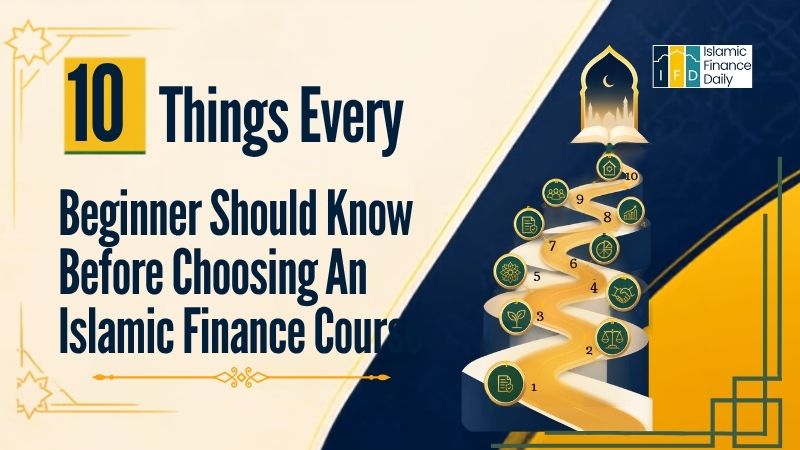
How to Choose an Islamic Finance Course: 10 Things Every Beginner Should Know
With so many Islamic finance courses available today, choosing the right one can feel overwhelming.
A quick online search will show courses from universities, professional training institutes, online learning platforms, and private academies. Some promise internationally recognised certificates, while others focus on practical skills or academic knowledge.
When I started learning about Islamic finance, I realised that the question wasn’t simply “Which course is the best?” It was “Which course is the right one for me?”
After completing a couple of introductory courses myself and researching many others, I’ve learned that the best course depends on your goals, your experience, and how you prefer to learn.
This guide shares the factors I believe every beginner should consider before enrolling in an Islamic finance course.
1. Start With Your Learning Goal
Before comparing providers or prices, ask yourself one question:
Why do you want to study Islamic finance?
Your answer will influence the type of course you should choose.
For example:
- Are you simply curious about Islamic banking?
- Are you preparing for a career in Islamic finance?
- Do you already work in banking and want to specialise?
- Are you studying for academic purposes?
- Are you looking for Continuing Professional Development (CPD)?
Knowing your objective makes the decision much easier.
2. Choose the Right Level
One of the most common mistakes beginners make is enrolling in an advanced programme too early.
If you’re completely new to Islamic finance, look for courses labelled:
- Beginner
- Foundation
- Introduction
- Essentials
These courses usually explain core concepts such as:
- Riba
- Gharar
- Islamic contracts
- Murabaha
- Musharakah
- Ijarah
- Sukuk
- Takaful
Once you understand these foundations, more advanced topics become much easier.
3. Research the Course Provider
The reputation of the provider matters.
Ask yourself:
- Does the organisation specialise in Islamic finance?
- Who developed the course?
- Are the instructors experienced?
- Is the curriculum clearly explained?
- Has the provider been offering Islamic finance education for several years?
A reputable provider is often a better indicator of quality than flashy marketing.
4. Review the Course Curriculum
Don’t enrol based only on the course title.
Spend a few minutes reviewing the syllabus.
A good beginner course should explain:
- The principles of Islamic finance
- Differences between Islamic and conventional finance
- Islamic banking products
- Ethical foundations
- Real-world examples
A clear curriculum usually reflects a well-designed course.
5. Decide Between Online and Classroom Learning
Every learner is different.
Online learning offers flexibility and allows you to study at your own pace.
Classroom learning provides face-to-face interaction, networking opportunities, and structured teaching.
Neither option is automatically better.
Choose the format that fits your schedule, learning style, and personal commitments.
6. Compare Time Commitment
Some courses can be completed over a weekend.
Others require several months of study.
Before enrolling, ask yourself:
- Can I realistically complete this course?
- Will I have enough time each week?
- Does the pace suit my current commitments?
Finishing a shorter course is often more valuable than abandoning a longer one halfway through.
7. Don’t Focus Only on the Certificate
Certificates are useful, but they shouldn’t be the main reason for studying.
The real value comes from understanding the concepts and being able to apply them.
A respected certificate is certainly a bonus, but knowledge should always come first.
8. Read Independent Reviews
Whenever possible, look beyond the provider’s own website.
Read reviews from previous learners, watch independent discussions, or ask professionals in the industry for recommendations.
No course is perfect, but consistent positive feedback can give you confidence in your decision.
9. Consider the Cost
A more expensive course isn’t always a better course.
Likewise, a free course can sometimes provide an excellent introduction.
Instead of asking:
“What’s the cheapest course?”
Ask:
“Which course gives me the best value for my current learning goals?”
10. Think Beyond Your First Course
Your first course won’t teach you everything.
Islamic finance covers many specialist areas, including:
- Islamic Banking
- Sukuk
- Takaful
- Islamic Capital Markets
- Islamic Fintech
- Shariah Governance
- Islamic Accounting
- Risk Management
Think of your first course as the foundation for future learning rather than the final destination.
My Personal Approach
When choosing courses for myself, I usually look at four things:
- Is the provider well established?
- Does the curriculum cover practical as well as theoretical concepts?
- Is the course suitable for my current knowledge level?
- Will it genuinely improve my understanding rather than simply provide a certificate?
These questions have helped me avoid choosing courses based purely on marketing.
Final Thoughts
Choosing an Islamic finance course isn’t about finding the most popular provider or the longest certificate.
It’s about finding a course that matches your current knowledge, your goals, and the way you learn best.
Start with the fundamentals, build your confidence, and continue learning over time.
Islamic finance is a broad and constantly evolving field, and every course you complete becomes another step in your learning journey.
Author’s Note
This article combines personal experience with independent research.
The recommendations and observations are based on the Islamic finance courses I have personally completed, together with research into course providers, curricula, and learner experiences. Rather than promoting any single institution, the aim is to help readers make informed decisions based on their own goals and learning needs.
As I continue reviewing additional courses, this guide will be updated with further firsthand insights to ensure it remains practical, balanced, and useful for future learners.
Write to us at editor@islamicfinancedaily.com