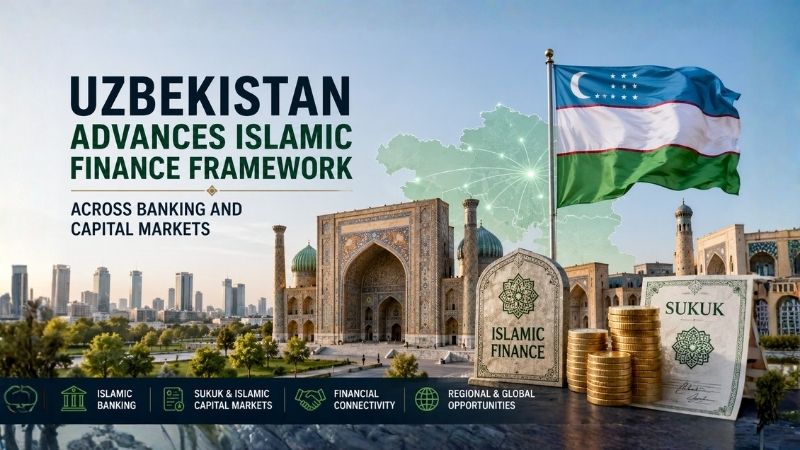
Uzbekistan Advances Islamic Finance Framework as Central Asia Seeks Greater Financial Connectivity
Uzbekistan is continuing to develop its Islamic finance framework as part of broader efforts to diversify its financial system and strengthen connections with international capital markets, according to Central Bank of Uzbekistan Governor Timur Ishmetov.
Speaking at the Silk Road Finance & Technology Forum in Tashkent on 26 August, Ishmetov outlined the country’s approach to developing Islamic finance across microfinance, banking and capital markets.
Islamic Microfinance and Banking
According to Ishmetov, Uzbekistan has established an initial layer of Islamic finance infrastructure through Islamic microfinance. Twelve microfinance organizations currently provide Islamic financial services using contracts including Murabaha, Ijara, Salam, Mudaraba and Musharakah.
The next stage has focused on Islamic banking. A law adopted on 29 June established a legal framework for Islamic banking activities in Uzbekistan and allows both fully fledged Islamic banks and Islamic banking windows within conventional banks to operate under dedicated Islamic banking licences.
Ishmetov also highlighted taxation as one of the challenges in developing Islamic finance, particularly the need for neutrality between conventional and Islamic financial transactions. The new legislation includes a dedicated taxation regime addressing areas such as value-added and income taxes, as well as relevant exemptions from state duties.
Focus on Islamic Capital Markets
The third stage of Uzbekistan’s approach involves developing an Islamic capital market.
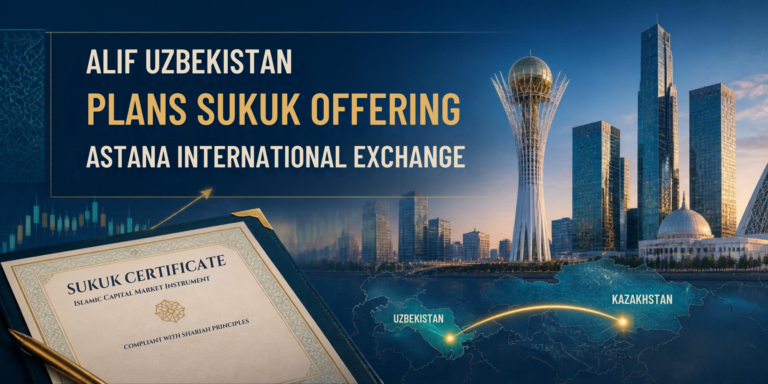
The Central Bank governor said a draft capital markets law includes a dedicated chapter covering Sukuk, or Islamic bonds, and had received first-reading approval from the Legislative Chamber of Parliament.
Uzbekistan has also developed a 2026–2030 roadmap for the national Islamic finance industry in cooperation with the Islamic Financial Services Board (IFSB). The roadmap, approved by the Cabinet of Ministers, contains 39 measures across five thematic areas.
The areas of focus include strengthening the legal and regulatory framework, developing human capital, increasing public awareness, expanding international cooperation, facilitating the start of Islamic banking operations and developing supporting infrastructure for Islamic finance.
FinTech and Islamic Finance
Ishmetov also linked the development of Islamic finance with Uzbekistan’s wider digital transformation.
He described FinTech as an important enabler of the Islamic finance ecosystem and highlighted the potential role of digital financial services in improving efficiency and transparency and enabling financial products to reach customers at greater scale.
The Tashkent forum also addressed wider financial technology and connectivity topics, including digital payments, artificial intelligence, tokenization, digital assets and cross-border financial infrastructure.
The development of Islamic finance could also provide Central Asia with additional connections to capital markets in the Gulf, Türkiye, and South and Southeast Asia, according to the report. Uzbekistan’s emerging regulatory framework could support both domestic Islamic finance activity and wider regional financial integration.
Source
Source: The Astana Times
Published: 26 August 2026
Original Article: Central Asia Explores Islamic Finance as Path to Greater Financial Connectivity
Industry Impact
Uzbekistan’s development of Islamic finance across microfinance, banking and capital markets indicates that the country’s Islamic finance framework is moving beyond individual products toward a broader regulatory and market structure. The inclusion of Sukuk and the 2026–2030 national roadmap also gives the sector a defined area of development within the country’s financial system.
Disclaimer
DISCLAIMER

IslamicFinanceDaily.com publishes this article for informational purposes only. The content is based on publicly available information and official announcements from the referenced institution. IslamicFinanceDaily.com does not provide financial, investment, or legal advice. Readers should verify information with the original source before making any financial or business decisions.

We strive to ensure the accuracy of all published content. If you represent the referenced organisation or identify any factual inaccuracy or misinterpretation, please contact us so that we can review and, where appropriate, update the article promptly.