Indonesia Islamic Finance Industry: Complete Overview
Country: Indonesia
Series: Global Islamic Finance Industry by Country
Research updated: November 2026
1. Introduction
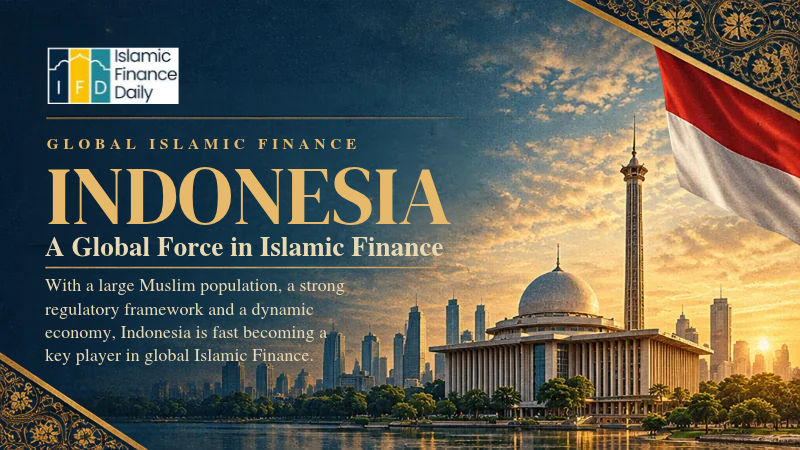
Indonesia is one of the world’s most significant markets for Islamic finance, supported by a large Muslim population, an expanding domestic financial sector and government initiatives aimed at developing a comprehensive Islamic financial ecosystem.
The country’s Islamic finance industry encompasses Islamic banking, sukuk, Islamic capital markets, takaful, Islamic investment management, financial technology and Islamic social finance.
Unlike some established Islamic finance markets, Indonesia’s development has placed considerable emphasis on connecting commercial Islamic finance with the wider halal economy, micro, small and medium-sized enterprises (MSMEs), financial inclusion and social finance.
Indonesia has also established a dedicated regulatory and institutional framework to support the sector’s development. The Financial Services Authority (OJK), Bank Indonesia, the National Sharia Council of the Indonesian Ulema Council (DSN-MUI) and other national institutions contribute to the development and oversight of the industry.
According to the 2026 Islamic Finance Development Indicator (IFDI), published by the Islamic Corporation for the Development of the Private Sector (ICD) in collaboration with London Stock Exchange Group (LSEG), Indonesia ranked fourth among 140 countries assessed.
This position reflects the country’s established Islamic finance ecosystem, although the industry continues to have considerable opportunities for further expansion.
2. Historical Development of Islamic Finance in Indonesia
Indonesia’s Islamic finance development began through academic discussions, community initiatives and efforts to establish financial institutions operating in accordance with Islamic principles.
Early discussions about Islamic banking took place during the 1980s. Some experimental initiatives included Bait At-Tamwil Salman ITB in Bandung and Koperasi Ridho Gusti in Jakarta.
A significant milestone occurred in 1990 when the Indonesian Ulema Council (Majelis Ulama Indonesia – MUI) organised discussions on banking and interest. These discussions led to the establishment of a working group tasked with preparing the foundation for an Islamic bank.
The outcome was the establishment of PT Bank Muamalat Indonesia on 1 November 1991. The bank officially commenced operations on 1 May 1992, becoming Indonesia’s first Islamic commercial bank.
The development of Islamic banking received further legal support through Law No. 7 of 1992 concerning Banking, which initially accommodated profit-sharing banking arrangements.
In 1998, Law No. 10 of 1998 amended the banking legislation and provided clearer recognition of the dual banking system, allowing conventional and Islamic banking to operate within the Indonesian financial system.
Two further legislative developments were particularly important:
- Law No. 19 of 2008 concerning State Sharia Securities (SBSN): Established the legal framework for government sukuk issuance.
- Law No. 21 of 2008 concerning Islamic Banking: Provided a dedicated legal framework for Islamic banking activities.
Indonesia issued its first sovereign sukuk in August 2008, following the enactment of the State Sharia Securities Law.
These developments helped establish the legal and institutional foundations for the expansion of Islamic banking and capital markets.
Source: OJK’s historical overview of Islamic banking in Indonesia.
3. Regulatory and Shariah Governance Framework
Indonesia’s Islamic finance industry operates under a regulatory framework involving financial authorities, central banking institutions and Shariah advisory bodies.
Financial Services Authority (OJK)
The Financial Services Authority, known as Otoritas Jasa Keuangan (OJK), is responsible for regulating and supervising financial services activities in Indonesia.
Its responsibilities include oversight of:
- Islamic commercial banks and Islamic banking units.
- Islamic capital markets.
- Sukuk and Shariah-compliant securities.
- Islamic insurance and takaful.
- Islamic financing institutions.
- Other regulated Islamic financial services.
OJK has introduced sector-specific development strategies, including the Roadmap for the Development and Strengthening of Indonesian Islamic Banking (RP3SI) 2023–2027.
The roadmap focuses on five areas:
- Strengthening the structure and resilience of Islamic banking.
- Accelerating digitalisation.
- Enhancing the distinctive characteristics of Islamic banking.
- Increasing Islamic banking’s contribution to the national economy.
- Strengthening regulation, licensing and supervision.
Bank Indonesia (BI)
Bank Indonesia is the country’s central bank.
Its responsibilities include monetary policy, payment systems and macroprudential policy, alongside initiatives supporting the development of the Islamic economy and finance sector.
Bank Indonesia also promotes Islamic money market development, Islamic financial market infrastructure, research and financial inclusion.
Its Sharia Economic and Financial Review (KEKSI) provides an important reference for understanding the country’s Islamic economy and financial development.
National Sharia Council – Indonesian Ulema Council (DSN-MUI)
The National Sharia Council of the Indonesian Ulema Council, known as Dewan Syariah Nasional – Majelis Ulama Indonesia (DSN-MUI), plays an important role in Islamic finance governance.
It issues Shariah fatwas and guidance relating to Islamic financial products and activities.
Islamic financial institutions also maintain Shariah Supervisory Boards (Dewan Pengawas Syariah – DPS), which oversee the implementation of Shariah principles within their respective institutions.
Sharia Financial Development Committee (KPKS)
The Sharia Financial Development Committee (Komite Pengembangan Keuangan Syariah – KPKS) was established in June 2025 as a platform to strengthen coordination among stakeholders and support more integrated Islamic finance policies.
Its establishment reflects efforts to improve cooperation between regulators and other participants in the national Islamic finance ecosystem.
4. Islamic Banking in Indonesia
Islamic banking is one of the principal components of Indonesia’s Islamic finance industry.
The country operates a dual banking system in which Islamic commercial banks and Islamic banking units operate alongside conventional banks.
Islamic banking institutions provide financial products and services to individuals, businesses, corporations and government-related entities.
These include:
- Savings and deposit products.
- Consumer financing.
- Home financing.
- Business and corporate financing.
- Trade finance.
- Working capital facilities.
- Islamic treasury and liquidity management.
Size of the Islamic banking sector
According to OJK’s 2025 Sharia Financial Development Report, Indonesian Islamic banking assets reached IDR1,067.73 trillion at the end of 2025, representing annual growth of 8.92%.
Islamic banking financing reached IDR705.22 trillion, growing by 9.58% year-on-year, according to OJK’s December 2025 sector update.
Despite this growth, Islamic banking represented approximately 7.69% of Indonesia’s total banking assets at the end of 2025.
This indicates that the sector still has significant room to expand its presence in the national banking market.
Bank Syariah Indonesia (BSI)
Bank Syariah Indonesia (BSI) is one of the country’s most significant Islamic banking institutions.
Established in February 2021 through the merger of three state-owned Islamic banks, BSI became a major institution in Indonesia’s Islamic banking sector.
Its establishment was an important step towards strengthening the scale, competitiveness and reach of Islamic banking services.
Other institutions also contribute to the sector, including Bank Muamalat Indonesia and various Islamic banking units operating within the dual banking system.
5. Sukuk and Islamic Capital Markets
Indonesia has developed an important sovereign and corporate sukuk market.
Sukuk play a significant role in government financing, infrastructure development and corporate funding.
The country’s sukuk market includes:
- Government sukuk, known as Surat Berharga Syariah Negara (SBSN).
- Corporate sukuk.
- Retail sukuk.
- Savings sukuk.
- International sovereign sukuk.
- Sustainable and green sukuk.
Government sukuk
The legal foundation for sovereign sukuk was established through Law No. 19 of 2008 concerning State Sharia Securities.
The Indonesian government issued its first sovereign sukuk in August 2008.
Since then, government sukuk have become an important financing instrument, supporting the government’s funding requirements and eligible development projects.
Corporate sukuk
Corporate sukuk provide companies and other eligible issuers with an alternative means of raising capital through Shariah-compliant structures.
The Indonesia Stock Exchange (IDX) recognises government and corporate sukuk as important components of the country’s Islamic capital market.
Sustainable and green sukuk
Indonesia has also become an important participant in the international sustainable sukuk market.
The government introduced sovereign green sukuk in 2018, using the instrument to finance eligible environmental and climate-related expenditure.
According to Bank Indonesia, cumulative sovereign green sukuk issuance since 2018 had reached:
- USD7.7 billion in international markets.
- IDR108.9 trillion in domestic markets.
These figures were reported as of June 2026.
The development of green sukuk demonstrates how Islamic capital market instruments can be used alongside broader sustainable finance initiatives.
6. Takaful and Islamic Non-Bank Financial Institutions
Indonesia’s Islamic non-bank financial sector includes Islamic insurance, takaful, financing institutions, venture capital, microfinance and other financial services.
Takaful provides Shariah-compliant protection services based on mutual assistance and shared responsibility.
The Indonesian market includes family and general Islamic insurance products.
The development of the sector is supported by the country’s broader insurance regulatory framework and OJK supervision.
Industry developments
OJK’s 2025 Sharia Financial Development Report recorded assets of IDR74.27 trillion for the Islamic insurance, guarantee and pension fund sector, representing annual growth of 10.59%.
This figure covers the wider regulated sector and should not be interpreted as takaful assets alone.
The report also recorded IDR124.51 trillion in assets for Islamic financing institutions, venture capital companies, microfinance institutions and other financial service companies, representing annual growth of 10.29%.
Regulatory developments
OJK Regulation No. 11 of 2023 introduced requirements concerning the separation of Islamic business units within insurance and other regulated financial institutions.
The spin-off process is an important development for the sector because it is intended to strengthen the institutional structure of standalone Islamic insurance businesses.
The transition also presents operational and capital-related challenges for companies completing the process.
7. Islamic Investment and Asset Management
Indonesia’s Islamic capital market offers investment opportunities through Shariah-compliant shares, sukuk, mutual funds and other investment products.
The Indonesia Stock Exchange provides a dedicated Islamic capital market segment, including access to Shariah-compliant securities.
Important components include:
- Shariah-compliant listed shares.
- Islamic mutual funds.
- Government and corporate sukuk.
- Shariah securities crowdfunding.
- Islamic investment management products.
OJK maintains a Shariah-compliant securities list, known as the Daftar Efek Syariah (DES), which identifies securities meeting the applicable Shariah criteria.
The Islamic investment market provides opportunities for both individual and institutional investors.
It also supports the broader development of Indonesia’s capital markets by offering investment products structured in accordance with Islamic principles.
8. Islamic Fintech and Digital Financial Services
Indonesia’s digital economy provides opportunities for the expansion of Islamic financial technology.
The country’s Islamic fintech ecosystem includes businesses and initiatives involving:
- Digital Islamic financing.
- Shariah-compliant peer-to-peer financing.
- Islamic payment solutions.
- Digital investment platforms.
- Islamic crowdfunding.
- Financial technology supporting MSMEs.
Islamic fintech can contribute to wider financial inclusion by improving access to financial services for individuals and businesses that may be underserved by traditional financial institutions.
OJK regulates relevant financial technology activities within its supervisory framework.
However, not all fintech businesses operating in Indonesia are Islamic or Shariah-compliant. Their classification should be based on their actual business models, products and Shariah governance arrangements.
The development of digital Islamic finance also requires attention to consumer protection, cybersecurity, responsible financing and Shariah compliance.
9. Islamic Economy, Zakat and Social Finance
One distinctive feature of Indonesia’s Islamic finance ecosystem is the connection between commercial financial services and Islamic social finance.
Islamic social finance includes zakat, waqf, infaq and sadaqah, which contribute to social welfare, poverty alleviation and community development.
Important institutions include:
- BAZNAS: The National Amil Zakat Agency, responsible for national-level zakat management and coordination.
- Badan Wakaf Indonesia (BWI): The Indonesian Waqf Board, which supports the development and management of waqf.
- Bank Indonesia: Contributes to research, policy coordination and the development of Islamic social finance.
- OJK: Supports the development of regulated Islamic financial services and their contribution to financial inclusion.
Integration with the halal economy
Indonesia’s Islamic economy extends beyond financial services into sectors such as halal food, modest fashion, pharmaceuticals, cosmetics, Muslim-friendly tourism and other halal industries.
The government and Bank Indonesia have promoted stronger connections between Islamic finance and the halal value chain.
This approach aims to increase access to financing for businesses, particularly MSMEs, while strengthening the contribution of Islamic financial institutions to productive economic activities.
The Indonesia Sharia Economic Festival (ISEF) is one of the country’s major platforms for bringing together stakeholders from Islamic finance, the halal industry, research and social finance.
At ISEF 2026, Bank Indonesia highlighted initiatives involving Islamic financial market development, zakat governance and human resource development.
10. Islamic Finance Education, Research and Professional Development
Indonesia has developed an academic and research ecosystem supporting Islamic economics and finance.
Universities, research institutions and professional organisations contribute through undergraduate and postgraduate programmes, academic publications, professional training and industry collaboration.
Examples of institutions involved in Islamic economics and finance education include:
- Tazkia Institute.
- International Islamic University Indonesia (UIII).
- Universitas Islam Indonesia (UII).
- Universitas Airlangga.
- Universitas Indonesia.
- State Islamic University institutions (UIN).
Research is also supported by Bank Indonesia through its research and educational activities.
One example is the Journal of Islamic Monetary Economics and Finance (JIMF), published through the Bank Indonesia Institute.
The development of Islamic finance education is important for building professional capabilities in areas such as Islamic banking, Shariah governance, Islamic capital markets, takaful, Islamic economics and Islamic social finance.
11. Indonesia’s International Position in Islamic Finance
Indonesia holds an important position in the global Islamic finance industry.
According to the 2026 ICD–LSEG Islamic Finance Development Indicator, Indonesia ranked fourth globally, following Malaysia, Saudi Arabia and the United Arab Emirates.
Its position reflects the development of its Islamic financial institutions, regulatory framework, research and knowledge ecosystem, capital markets and broader Islamic economy.
Indonesia’s Islamic finance industry recorded total assets of IDR3,131.02 trillion in 2025, according to OJK.
Bank Indonesia subsequently reported that Islamic financial assets reached approximately IDR3,264 trillion as of June 2026, representing growth of nearly 10%.
The country also maintains an important position in sovereign sukuk and sustainable finance.
Its international activities include participation in Islamic finance research, cross-border investment, sustainable sukuk markets and cooperation with international Islamic finance institutions.
Indonesia’s experience is particularly relevant to emerging Islamic finance markets seeking to connect financial development with financial inclusion and the wider real economy.
12. Recent Developments and Future Direction
Indonesia’s Islamic finance development agenda continues to evolve through regulatory initiatives, institutional cooperation and digital transformation.
Several developments are particularly important.
Islamic banking development
OJK’s RP3SI 2023–2027 provides a framework for strengthening Islamic banking institutions, accelerating digitalisation and improving their contribution to the national economy.
Financial market development
Bank Indonesia is working to deepen Islamic financial markets and strengthen the infrastructure supporting Shariah-compliant transactions.
At ISEF 2026, the Islamic Financial Market Code of Conduct (ICoC) was introduced to support market integrity and efficiency.
Sustainable finance
Indonesia’s sovereign green sukuk programme continues to demonstrate the potential for Islamic financial instruments to contribute to environmental and climate-related financing.
Takaful restructuring
The separation of Islamic insurance business units remains an important regulatory development as the industry works towards strengthening standalone Islamic insurance institutions.
Financial inclusion and social finance
Initiatives connecting Islamic finance with zakat, waqf, MSME financing and the halal economy remain central to Indonesia’s wider development strategy.
These developments demonstrate that Indonesia’s ambitions extend beyond increasing Islamic financial assets. The country is also working to strengthen institutional capacity, deepen financial markets, improve accessibility and connect Islamic finance with productive economic activities.
13. Conclusion
Indonesia has developed a substantial Islamic finance ecosystem through a combination of legislative reforms, financial regulation, institutional development and initiatives supporting the wider Islamic economy.
From the establishment of Bank Muamalat Indonesia in 1991 to the development of sovereign sukuk, Islamic banking, takaful, Islamic investment products and digital financial services, the country has progressively strengthened its position in the global Islamic finance industry.
Its fourth-place position in the 2026 Islamic Finance Development Indicator demonstrates its international standing.
Nevertheless, the relatively low share of Islamic banking in the overall banking market highlights an important development opportunity.
Indonesia’s future progress will depend on its ability to expand Islamic financial services, strengthen institutional competitiveness, develop professional expertise and connect commercial Islamic finance with the wider economy.
The country’s experience provides an important reference for understanding how Islamic finance can contribute to financial inclusion, economic development and sustainable growth.
References and Further Reading
- Otoritas Jasa Keuangan (OJK) – 2025 Sharia Financial Development Report (LPKSI)
- OJK – History of Islamic Banking in Indonesia
- OJK – Roadmap for the Development and Strengthening of Indonesian Islamic Banking 2023–2027
- Bank Indonesia – Sharia Economic and Financial Review 2025
- Bank Indonesia – ISEF 2026: Goodness for All
- Indonesia Stock Exchange – Islamic Capital Market Products
- OJK – Law No. 19 of 2008 concerning State Sharia Securities
- LSEG and ICD – Islamic Finance Development Report 2026
Disclaimer: IslamicFinanceDaily.com publishes this article for informational purposes only. The content is based on publicly available information and official announcements from the referenced institution. IslamicFinanceDaily.com does not provide financial, investment, or legal advice. Readers should verify information with the original source before making any financial or business decisions.