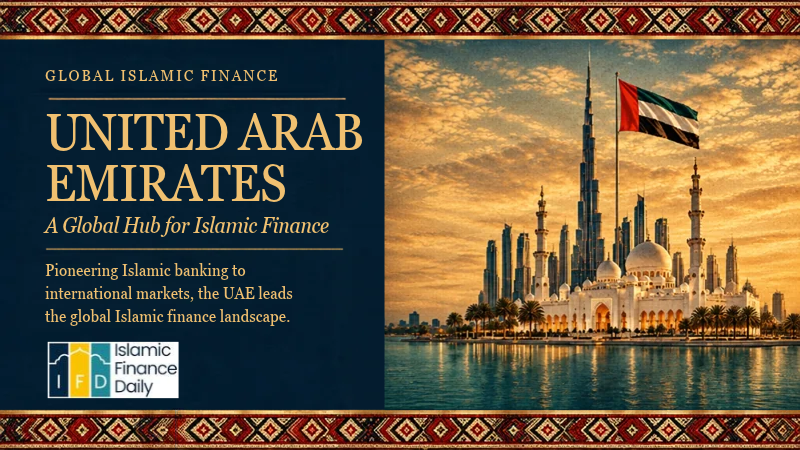
The United Arab Emirates Islamic Finance Industry: Complete Overview
1. Introduction: The UAE’s Islamic finance industry
The United Arab Emirates (UAE) has developed into one of the world’s leading centres for Islamic finance, supported by an established Islamic banking sector, an international sukuk market, specialised financial institutions and a regulatory framework designed to accommodate Shariah-compliant financial activities.
The country’s Islamic finance industry has developed alongside its broader financial services sector. Dubai and Abu Dhabi have become important centres for banking, capital markets, investment management and international financial services, while other emirates also contribute to the development of Islamic financial institutions.
The UAE’s role in Islamic finance is supported by its early entry into Islamic banking. The Central Bank of the UAE identifies 1975 as a significant milestone, when the country’s first Islamic commercial bank was established.
The industry has subsequently expanded beyond banking into takaful, sukuk, Islamic investment products and financial technology. The establishment of dedicated Shariah governance arrangements and the adoption of internationally recognised standards have also contributed to the development of the sector. Islamic Finance+1
In May 2025, the UAE Cabinet approved its Strategy for Islamic Finance and Halal Industry, setting targets for the expansion of Islamic banking assets and sukuk markets by 2031. This initiative reflects the country’s ambition to strengthen its position as an international centre for Islamic finance and the wider halal economy. LSEG Islamic Finance Development Report 2025
2. Historical development of Islamic finance in the UAE
The UAE has played an important role in the development of modern Islamic banking since the establishment of its first Islamic commercial bank in 1975.
The subsequent development of Islamic finance involved the expansion of Islamic banking services, the establishment of specialised financial institutions and the development of regulatory arrangements for Shariah-compliant activities.
Several important milestones shaped the country’s Islamic finance framework:
- 1975 – Introduction of Islamic commercial banking: The UAE established its first Islamic commercial bank, marking an early milestone in the development of modern Islamic banking.
- 2018 – Establishment of the Higher Shariah Authority: The Higher Shariah Authority (HSA) was established to support the standardisation of Shariah requirements and governance across licensed Islamic financial institutions.
- 2018 – Federal banking legislation: Federal Decree-Law No. 14 of 2018 strengthened the legal framework governing the Central Bank and financial institutions, including Islamic financial activities.
- 2019 – Adoption of AAOIFI standards: The UAE formally adopted standards issued by the Accounting and Auditing Organization for Islamic Financial Institutions (AAOIFI).
- 2020 – Adoption of IFSB prudential standards: The UAE adopted prudential standards issued by the Islamic Financial Services Board (IFSB).
- 2022 – Commercial Transactions Law: Federal Decree-Law No. 50 of 2022 introduced provisions addressing Islamic financial transactions and the legal interpretation of Shariah-related matters.
- 2024 – Expansion of Islamic financial assets: The CBUAE reported that total Islamic financial assets in the UAE had surpassed AED 1 trillion.
- 2025 – National Islamic Finance and Halal Industry Strategy: The Cabinet approved a national strategy with targets extending to 2031. Islamic Finance+3
These developments demonstrate the evolution of the UAE’s Islamic finance industry from an early Islamic banking market into a broader financial ecosystem supported by dedicated regulation and national development initiatives.
3. Regulatory framework and Shariah governance
The UAE’s Islamic finance regulatory framework involves several authorities responsible for banking supervision, Shariah governance, securities markets and financial services within specialised financial free zones.
Central Bank of the UAE (CBUAE)
The CBUAE is the principal federal regulator responsible for licensing and supervising banks and other financial institutions operating within its jurisdiction. It oversees Islamic banks, Islamic financing companies and takaful operators.
The Central Bank also develops regulations and standards applicable to Islamic financial institutions. Islamic Finance+2
Higher Shariah Authority (HSA)
The HSA operates under the Central Bank and serves as the principal reference for Shariah-related matters concerning licensed Islamic financial institutions.
Its responsibilities include:
- Establishing general rules and standards applicable to Islamic financial activities.
- Supervising and overseeing Internal Shariah Supervision Committees.
- Supporting the standardisation of Shariah practices.
- Reviewing relevant regulatory requirements and Islamic financial products.
- Approving Islamic monetary and financial instruments developed by the CBUAE.
The HSA also contributes to the adoption and implementation of AAOIFI standards. Its published work includes Shariah governance standards, guidance notes and resolutions concerning Islamic financial transactions. Higher Shari’ah Authority+1
Securities and Commodities Authority (SCA)
The SCA regulates securities-related activities within its federal jurisdiction. Its regulatory framework includes provisions for financial activities and products compliant with Islamic Shariah.
The SCA’s Article 40, under Resolution No. 33/2025, became effective on 1 January 2026 and refers to the role of the Higher Shariah Authority in determining relevant Shariah-compliant financial activities and products. CMA Rulebook
Dubai Financial Services Authority (DFSA)
The DFSA regulates financial services conducted in or from the Dubai International Financial Centre (DIFC). Its regulatory responsibilities include Islamic finance, banking, asset management, collective investment funds and securities.
DIFC provides a separate legal and regulatory environment for financial institutions, including firms offering Shariah-compliant products and services. dfsa.ae+1
Abu Dhabi Global Market (ADGM)
ADGM provides another international financial centre in the UAE, with its own financial services regulatory framework. It contributes to the country’s wider financial services ecosystem, including investment management and financial innovation.
Together, these regulatory institutions provide the framework within which Islamic financial institutions operate across the UAE.
4. Islamic banking sector
Islamic banking represents a major component of the UAE’s financial services industry.
The country has a well-established network of fully-fledged Islamic banks alongside conventional banks that offer Islamic banking services through dedicated windows.
The CBUAE’s published list of fully Islamic banks includes:
- Abu Dhabi Islamic Bank (ADIB)
- Al Hilal Bank
- Dubai Islamic Bank (DIB)
- Emirates Islamic Bank
- Ruya Community Islamic Bank
- Ajman Bank
- Sharjah Islamic Bank
The Central Bank also lists several conventional institutions offering Islamic banking windows, including First Abu Dhabi Bank, Emirates NBD, Mashreq and Abu Dhabi Commercial Bank. Islamic Banking
Islamic banks in the UAE provide services across retail, corporate and institutional banking. Their offerings include Shariah-compliant deposits, home financing, personal finance, trade finance, business financing and investment services.
The country’s Islamic banking industry has also attracted international attention because of its size and institutional development.
According to the CBUAE Annual Report 2024, Islamic banking assets surpassed AED 1 trillion, and the UAE improved its global Islamic finance ranking from sixth place in 2023 to third place in 2024. 2024
The government’s 2031 strategy aims to increase Islamic banking assets to AED 2.56 trillion, providing a longer-term development target for the sector. LSEG Islamic Finance Development Report 2025
5. Sukuk and Islamic capital markets
The UAE is an important international centre for sukuk issuance and listing. Its capital markets provide access to regional and international investors, with Dubai playing a particularly significant role in the global sukuk market.
Nasdaq Dubai
Nasdaq Dubai is one of the principal international venues for sukuk listings.
Its market attracts sovereign, government-related, supranational, financial institution and corporate issuers.
According to its 2025 Annual Review, Nasdaq Dubai recorded:
- 51 sukuk listings valued at approximately US$25.63 billion during 2025.
- 60 total debt listings valued at US$30.6 billion.
- More than US$100 billion in outstanding sukuk listings by the end of 2025.
- More than US$245 billion in cumulative bond and sukuk issuances since inception, including US$177 billion in sukuk. English+1
Government sukuk initiatives
The UAE Federal Government has also developed its Treasury Sukuk Programme, providing dirham-denominated Shariah-compliant investment instruments.
An important development occurred in 2026 with the introduction of the UAE’s Sovereign Retail T-Sukuk Programme.
The inaugural issuance was initially announced at AED 50 million and subsequently increased to AED 100 million following investor demand. It had a minimum investment threshold of AED 1,000 and was listed through Nasdaq Dubai. United Arab Emirates
The second five-year sovereign retail T-Sukuk was listed in October 2026, with secondary-market trading commencing on Nasdaq Dubai. United Arab Emirates
Islamic capital market development
The UAE’s Islamic capital market extends beyond sovereign sukuk to include corporate sukuk, Islamic investment products and Shariah-compliant securities.
The Dubai Financial Market (DFM) also provides Shariah compliance standards for identifying and trading eligible shares. Shari’a Compliance: The Authoritative Voice
Under the national strategy, the UAE aims to increase locally listed sukuk to AED 660 billion and internationally listed sukuk to AED 395 billion by 2031.
6. Takaful industry
Takaful is an established component of the UAE’s Islamic financial services sector.
The CBUAE is responsible for regulating and supervising insurance companies, including takaful operators.
The UAE Islamic Finance Report 2023, published by the CBUAE, recorded ten takaful operators among the country’s 62 insurance companies in 2022. The report also recorded takaful gross written contributions of approximately AED 4.6 billion for that year. centralbank.ae
The CBUAE’s published list of licensed takaful companies includes:
- Abu Dhabi National Takaful Company
- Islamic Arab Insurance Company (SALAMA)
- Sukoon Takaful
- Takaful Emarat
- YAS Takaful
- Orient Takaful
- Dubai Islamic Insurance and Reinsurance Company (AMAN)
- Watania Takaful General
- Watania Takaful Family
- Methaq Takaful Insurance. Takaful Insurance
These companies provide insurance solutions structured around Shariah principles, including family and general takaful products.
The sector forms part of the UAE’s wider Islamic finance ecosystem and operates under dedicated regulatory and Shariah governance requirements.
7. Islamic investment and asset management
The UAE has developed an investment management environment that includes Shariah-compliant funds, Islamic investment products and asset management services.
The Dubai International Financial Centre provides an important platform for fund managers and investment firms operating under the DFSA regulatory framework.
The DFSA maintains a public register of investment funds, which includes Shariah-compliant products.
Examples include:
- Mashreq Al Islami Equity Fund, managed by Mashreq Capital.
- Guidance ATEL GCC Leasing Fund.
- Other Shariah-compliant investment products registered within the DIFC framework. THE INDEPENDENT REGULATOR OF FINANCIAL SERVICES+1
The Mashreq Al Islami Equity Fund, for example, is a Shariah-compliant open-ended fund domiciled in the DIFC. Its investment objective is long-term capital appreciation through investments primarily in Shariah-compliant equities listed across the Middle East and North Africa. Rise everyday
Islamic investment opportunities are also available through Islamic banks and other licensed financial institutions.
The development of this segment provides additional avenues for investors seeking Shariah-compliant exposure to equities, income-generating assets and other investment opportunities.
8. Islamic fintech and financial innovation
The UAE has positioned financial technology as an important part of its broader financial services development strategy.
The CBUAE established its FinTech Office in 2020 to support the development of the national fintech ecosystem. Its work focuses on five pillars: demand, capital, policy, talent and infrastructure. FinTech & Digital Transformation
Within Islamic finance, digital innovation is relevant to banking, SME financing, investment management, payments and financial inclusion.
Examples of Islamic fintech activity
Beehive
Beehive is a Dubai-based digital SME financing platform that offers Shariah-compliant financing opportunities through Commodity Murabaha structures.
The company operates under DFSA regulation and provides a digital platform connecting businesses seeking finance with investors. Beehive P2P Lending Platform+1
Emirates Islamic fintech initiatives
Emirates Islamic has introduced fintech collaboration initiatives to engage with technology companies and startups developing solutions for Islamic financial services.
Its collaboration programme with Plug and Play identifies opportunities in SME finance, trade finance and financial wellbeing. Emirates Islamic
These examples illustrate how technology is being incorporated into the UAE’s Islamic finance ecosystem, although they should not be interpreted as a complete list of Islamic fintech companies operating in the country.
9. Islamic finance education, research and professional development
The UAE has an established education and professional development environment supporting the financial services industry.
Universities and specialised institutions provide finance programmes, Islamic banking courses and professional training opportunities.
Dubai Centre for Islamic Banking and Finance (DCIBF)
The Dubai Centre for Islamic Banking and Finance, associated with Hamdan Bin Mohammed Smart University, supports education, training, research and professional development in Islamic banking and finance.
Its educational activities include professional certifications, undergraduate and postgraduate offerings, executive training and leadership development programmes. DCIBF
United Arab Emirates University (UAEU)
UAEU offers a Bachelor of Finance and Banking programme that includes Islamic Finance and Banking as part of its financial management concentration.
The programme also covers financial institutions, investment analysis, financial technology and other areas of finance. United Arab Emirates University (UAEU)+1
Zayed University
Zayed University’s Bachelor of Science in Finance includes an Islamic Banking and Finance area of study. Its programme introduces students to Islamic financial principles and their application in banking, insurance and investment management. Zayed University
Ajman University
Ajman University’s accredited Bachelor of Science in Finance programme includes an Islamic Finance concentration. CAA
These institutions contribute to the development of academic knowledge and professional capabilities needed by Islamic banks, financial institutions, regulators and other industry participants.
10. Key Islamic finance institutions and market participants
The UAE’s Islamic finance ecosystem consists of regulators, financial institutions, capital market operators, educational institutions and specialised service providers.
Some of the significant participants include:
| Institution | Role in the industry |
|---|---|
| Central Bank of the UAE | Banking and takaful regulation |
| Higher Shariah Authority | Shariah governance and standardisation |
| Abu Dhabi Islamic Bank | Islamic banking |
| Dubai Islamic Bank | Islamic banking |
| Emirates Islamic | Islamic banking |
| Sharjah Islamic Bank | Islamic banking |
| Ajman Bank | Islamic banking |
| Nasdaq Dubai | International sukuk and debt listings |
| Dubai Financial Market | Securities and Shariah-compliant market activities |
| Dubai International Financial Centre | Financial services and Islamic finance ecosystem |
| Dubai Centre for Islamic Banking and Finance | Islamic finance education and research |
| Beehive | Digital SME financing |
The institutions listed above represent selected participants rather than a complete directory of the UAE’s Islamic finance industry.
11. International participation and the UAE’s global role
The UAE’s position in international Islamic finance is supported by its financial infrastructure, international investor access and participation in global capital markets.
Dubai’s sukuk market attracts issuers from different jurisdictions, including sovereign governments, multilateral institutions, banks and corporations.
Nasdaq Dubai’s 2025 listings included issuances from the Islamic Development Bank, the Government of Ras Al Khaimah, the Republic of Indonesia and other international issuers. English
The country’s financial centres also provide international firms with access to the wider Middle East, Africa and South Asia region.
The UAE’s adoption of AAOIFI standards and IFSB prudential standards further connects its regulatory environment with internationally recognised Islamic finance frameworks. Islamic Finance+1
The country’s national strategy adds another dimension to this international role by setting measurable targets for Islamic banking and sukuk market expansion.
12. Challenges and future outlook
The UAE enters the next phase of Islamic finance development with an established banking sector, international capital market infrastructure and a national strategy extending to 2031.
However, several areas remain important to the industry’s future development.
Achieving the national strategy targets
The planned expansion of Islamic banking assets and sukuk listings will require sustained market development, institutional participation and effective implementation of the national strategy.
Strengthening Shariah governance
As Islamic financial products become more diverse, maintaining consistent Shariah governance and regulatory clarity remains important for market confidence.
Developing Islamic fintech
Technology offers opportunities to improve the delivery of Islamic financial services, particularly in digital banking, SME financing, payments and investment platforms.
Expanding takaful and Islamic investment products
Further development of takaful, Islamic funds and other Shariah-compliant investment products can broaden the range of financial services available to consumers and institutional investors.
Developing skilled professionals
The growth of the industry also increases the importance of specialised knowledge in Islamic banking, Shariah governance, financial regulation, risk management and Islamic capital markets.
Looking ahead, the UAE’s 2031 strategy provides a defined policy framework for the next stage of development. Its progress will be measured not only by the expansion of financial assets and sukuk listings but also by the strength of its institutions, regulatory arrangements, talent base and international market participation.
13. Conclusion
The United Arab Emirates has established itself as one of the leading Islamic finance markets globally. Its development has been supported by early Islamic banking initiatives, a growing network of Islamic financial institutions, centralised Shariah governance and an international sukuk market.
The UAE’s financial centres, including Dubai and Abu Dhabi, contribute to its role as a regional and international financial hub. The expansion of takaful, Islamic investment management, fintech and education further demonstrates the breadth of its Islamic finance ecosystem.
The approval of the Strategy for Islamic Finance and Halal Industry in 2025 represents an important step in the country’s long-term development agenda. With targets extending to 2031, the UAE aims to increase the scale of its Islamic banking and capital markets while strengthening its position in the global Islamic economy.
The country’s future progress will depend on the effective implementation of these objectives, continued institutional development and the ability to sustain innovation while maintaining sound Shariah governance.
14. References and research sources
The following sources were used to prepare the article. Official regulatory and institutional sources are prioritised.
- ICD–LSEG: Islamic Finance Development Report 2026.
- ICD–LSEG: Islamic Finance Development Report 2025.
- Central Bank of the UAE: Islamic Finance in the UAE.
- Central Bank of the UAE: Higher Shariah Authority.
- Central Bank of the UAE: Licensed Islamic Banks.
- Central Bank of the UAE: Licensed Takaful Companies.
- Central Bank of the UAE: UAE Islamic Finance Report 2023.
- Central Bank of the UAE: Annual Report 2024.
- Nasdaq Dubai: Annual Review 2025.
- UAE Ministry of Finance: Sovereign Retail T-Sukuk Programme.
- UAE Ministry of Finance: Second Sovereign Retail T-Sukuk.
- Dubai Financial Services Authority: Official Website.
- Dubai Centre for Islamic Banking and Finance: Education and Training.
- United Arab Emirates University: Bachelor of Finance and Banking.
DISCLAIMER
IslamicFinanceDaily.com publishes this article for informational purposes only. The content is based on publicly available information and official announcements from the referenced institution. IslamicFinanceDaily.com does not provide financial, investment, or legal advice. Readers should verify information with the original source before making any financial or business decisions.