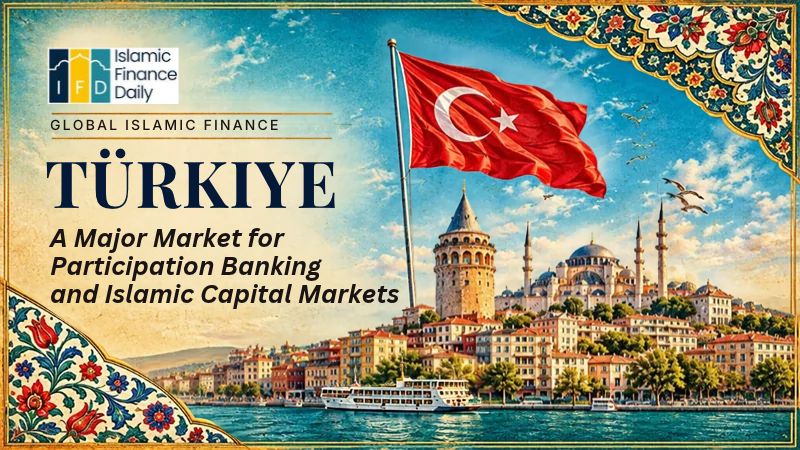
Türkiye Islamic Finance Industry: Complete Overview:
Türkiye (Turkey) is an important market in the development of Islamic finance, where the industry is commonly known as participation finance (katılım finans). Its financial system includes participation banks, government and corporate sukuk issuances, participation insurance, Islamic investment funds and an expanding academic and professional education sector.
An important feature of Türkiye’s market is that participation finance operates alongside a much larger conventional financial system. Its development therefore needs to be assessed not only by the number of institutions and financial products available, but also by its market share, regulatory framework, capital-market activity and international connections.
The following country profile examines these areas, distinguishing established activities from announced policy initiatives and future ambitions.
1. Introduction
Türkiye has developed an Islamic finance industry that encompasses banking, capital markets, insurance, investment management and financial technology. Unlike countries where Islamic banking operates as a separate or dominant banking system, Türkiye maintains a dual banking structure in which conventional and participation banks operate under the same national financial system.
The term participation banking is widely used in Türkiye to describe Islamic banking. Participation banks mobilise funds through participation accounts and provide financing through structures designed to comply with participation finance principles, rather than relying on conventional interest-based lending and deposit-taking.
The sector has received increasing attention from policymakers as part of Türkiye’s broader strategy to diversify its financial system, attract international investment and strengthen Istanbul’s position as a regional financial centre.
By August 2026, Türkiye’s participation banking sector had reached approximately TRY 5.35 trillion in assets, according to the Türkiye Participation Banks Association (TKBB). The country also has ten licensed participation banks, including three digital participation banks. en.tkbb.org.tr+1
The development of participation finance is also reflected in Türkiye’s international standing. The 2026 Islamic Finance Development Report, published by the Islamic Corporation for the Development of the Private Sector (ICD) and London Stock Exchange Group (LSEG), placed Türkiye ninth globally in the Islamic Finance Development Indicator (IFDI), with a score of 46. icd-ps.org+1
These developments demonstrate that Türkiye has an established participation finance infrastructure, although the sector continues to represent a relatively small share of the country’s overall banking industry.
2. Historical Development of Islamic Finance in Türkiye
The development of modern Islamic banking in Türkiye began during the early 1980s, when the government introduced a legal framework allowing financial institutions to operate according to interest-free financing principles.
2.1 Introduction of Special Finance Houses
In December 1983, the Turkish government introduced a decree permitting the establishment of institutions known as Special Finance Houses (Özel Finans Kurumları).
These institutions were designed to provide financial services without operating through conventional interest-based banking arrangements.
The first institutions began operations in 1985, marking the beginning of organised Islamic banking activity in Türkiye.
Initially, Special Finance Houses operated under a different institutional and regulatory framework from conventional banks. However, subsequent legal reforms gradually integrated them into the wider banking system.
2.2 Integration into the Banking System
A significant development occurred in 1999, when amendments to the banking legislation brought Special Finance Houses within the scope of the banking regulatory framework.
In 2001, a professional association was established to represent the interests of these institutions and support the development of the sector.
The most important structural change came with the Banking Law No. 5411, adopted in 2005.
Under this legislation, the designation Special Finance House was replaced by Participation Bank (Katılım Bankası).
The reform established participation banking as a recognised component of Türkiye’s banking system and provided a clearer institutional foundation for its future development.
The Türkiye Participation Banks Association (TKBB) subsequently became the professional organisation representing participation banks. tkbb.org.tr+1
2.3 Expansion of Participation Banking
Following the 2005 reforms, the participation banking industry expanded through the entry of domestic and international financial institutions.
The establishment of state-owned participation banks was particularly significant.
Ziraat Participation Bank began operations in 2015, followed by Vakıf Participation Bank in 2016. Türkiye Emlak Participation Bank subsequently entered the market in 2019.
The expansion of digital banking has added another dimension to the industry, with new institutions receiving licences to operate as digital participation banks.
This development has broadened the institutional structure of the sector beyond traditional branch-based banking.
3. Regulatory and Shariah Governance Framework
Türkiye regulates participation finance through its national banking, capital-market and insurance regulatory institutions.
The regulatory structure is not based on a completely separate Islamic financial system. Instead, participation finance institutions operate within the wider Turkish financial regulatory framework, subject to additional requirements concerning compliance with participation principles.
3.1 Banking Regulation and Supervision Agency (BRSA)
The Banking Regulation and Supervision Agency, known in Türkiye as BDDK, is the principal authority responsible for regulating and supervising banks.
Its responsibilities include:
- Licensing and supervising participation banks.
- Monitoring capital adequacy and financial soundness.
- Supervising banking operations and risk management.
- Establishing regulatory requirements for participation finance institutions.
- Overseeing compliance with applicable participation finance regulations.
The BRSA’s regulatory responsibilities also extend to certain non-bank financial institutions operating under participation finance principles.
3.2 Central Bank of the Republic of Türkiye
The Central Bank of the Republic of Türkiye (CBRT) is responsible for monetary policy and the wider financial and payment-system infrastructure.
Its role is relevant to participation banks through banking-system liquidity, payment infrastructure, settlement arrangements and monetary operations.
Participation banks operate within the national financial system and must comply with applicable central banking and financial regulations.
3.3 Capital Markets Board of Türkiye
The Capital Markets Board of Türkiye (CMB), known as the Capital Markets Board or SPK, regulates the country’s capital markets.
Its responsibilities include:
- Regulating securities markets.
- Supervising investment funds.
- Establishing rules for capital-market instruments.
- Regulating asset management activities.
- Providing the regulatory framework for lease certificates, commonly known as sukuk.
The CMB plays an important role in the development of Türkiye’s Islamic capital markets.
3.4 Participation Finance Compliance and Shariah Governance
An important regulatory development occurred on 19 December 2025, when the BRSA published the Communiqué on Compliance with Participation Principles in the Official Gazette.
The communiqué establishes requirements for institutions conducting financial activities according to participation principles.
Its scope includes participation banks, participation finance companies and certain development and investment banks, as well as financial leasing, factoring, financing and asset management companies conducting participation-based activities.
It also provides for advisory committees, internal compliance arrangements, review of financial products and services, and participation finance audit procedures.
An important institutional feature is the Central Advisory Committee, established through cooperation between the Türkiye Banks Association, TKBB and the Financial Institutions Association.
This framework represents a move towards more consistent participation finance governance across different categories of financial institutions. Resmî Gazete+1
The communiqué should be distinguished from the earlier 2019 regulatory framework, which it replaced.
3.5 Other Relevant Institutions
| Institution | Main responsibility |
|---|---|
| BRSA (BDDK) | Banking regulation and supervision |
| CBRT | Monetary policy and payment systems |
| CMB (SPK) | Capital markets and investment funds |
| Insurance and Private Pension Regulation and Supervision Agency (SEDDK) | Insurance and private pension regulation |
| Treasury and Ministry of Finance | Government borrowing and public sukuk issuance |
| TKBB | Representation and development of participation banking |
Together, these institutions provide the regulatory and institutional foundation for Türkiye’s participation finance industry.
4. Islamic Banking in Türkiye
Participation banking is the most established and developed component of Türkiye’s Islamic finance industry.
The country’s participation banks provide services to individuals, businesses and institutional customers through a range of financing and investment arrangements.
These include participation accounts, trade financing, asset-based financing, leasing arrangements and other financial products structured according to participation principles.
4.1 Participation Banks Operating in Türkiye
According to the BRSA’s institutional register, Türkiye has ten licensed participation banks as of November 2026.
| Participation bank | Ownership or institutional background |
|---|---|
| Adil Participation Bank | Digital participation bank |
| Albaraka Türk Participation Bank | Privately owned |
| Dünya Participation Bank | Privately owned |
| Hayat Finans Participation Bank | Digital participation bank |
| Kuveyt Türk Participation Bank | Privately owned, with international institutional ownership |
| T.O.M. Participation Bank | Digital participation bank |
| Türkiye Emlak Participation Bank | State-owned |
| Türkiye Finans Participation Bank | Privately owned |
| Vakıf Participation Bank | State-owned |
| Ziraat Participation Bank | State-owned |
The BRSA identifies Adil Katılım, Hayat Finans and T.O.M. as digital banks. bddk.org.tr+1
The presence of both state-owned and privately owned institutions has contributed to the expansion of the participation banking market.
4.2 Participation Banking Market Size
Türkiye’s participation banking industry has experienced substantial growth in recent years.
The following figures are reported by TKBB for August 2026.
PARTICIPATION BANKING – AUGUST 2026
TRY 5.35tn
Total assets
TRY 3.56tn
Funds raised
TRY 2.75tn
Funds disbursed
TRY 64.7bn
Net profit
22.05m
Total customers
22,874
Employeesen.tkbb.org.tr+1
These figures illustrate the size of the participation banking sector. Funds raised and funds disbursed represent different balance-sheet activities and should not be treated as interchangeable measures of banking assets.
In May 2026, the Turkish Investment and Finance Office reported that participation banking assets had exceeded TRY 4.7 trillion, representing approximately 9.5% of the country’s banking industry. This is an earlier reporting point than the August TKBB figures. invest.gov.tr+1
4.3 Main Participation Banking Activities
Participation banks in Türkiye offer a range of products and services, including:
- Participation accounts for individuals and businesses.
- Murabaha-based trade and commodity financing.
- Ijarah and financial leasing arrangements.
- Partnership-based financing structures.
- Export and import financing.
- Corporate banking and cash management.
- Digital banking and payment services.
Murabaha and leasing-based structures are important components of the industry’s financing activities.
4.4 State-Owned Participation Banks
The participation banking industry has also benefited from the establishment of state-owned institutions.
Ziraat Participation Bank, Vakıf Participation Bank and Türkiye Emlak Participation Bank have contributed to the expansion of the sector’s institutional capacity.
Their presence has increased competition and broadened the availability of participation banking services.
4.5 Digital Participation Banking
Digital banking is an increasingly important feature of Türkiye’s participation finance industry.
The licensing of Adil Participation Bank, Hayat Finans and T.O.M. Participation Bank demonstrates the expansion of participation banking beyond conventional branch networks.
Digital institutions can provide account opening, payment services, financing applications and customer management through digital channels.
However, the number of digital participation banks should not be confused with the overall size of the Islamic fintech industry. Digital banking is one component of the broader financial technology ecosystem.
5. Islamic Non-Bank Financial Institutions
Türkiye’s participation finance industry extends beyond conventional participation banking.
Non-bank financial institutions provide additional financing and financial services through structures that can operate according to participation principles.
5.1 Participation-Based Financial Leasing
Financial leasing is an important financing mechanism in Türkiye.
Under participation-based leasing arrangements, financing can be structured around the acquisition and leasing of assets rather than conventional interest-bearing lending.
These arrangements are relevant to businesses requiring machinery, equipment, vehicles and other productive assets.
5.2 Participation-Based Factoring and Financing
Factoring and financing companies also form part of the wider non-bank financial system.
The December 2025 BRSA communiqué specifically includes financial leasing, factoring and financing companies conducting participation-based activities within its regulatory scope.
This creates a broader framework for participation finance activities outside traditional banking. Resmî Gazete
5.3 Savings Finance Companies
Türkiye has a distinctive savings finance sector in which companies provide arrangements for customers seeking to acquire housing, vehicles and other assets through collective savings and financing models.
Some companies operate according to participation principles.
These institutions are subject to their own regulatory requirements and should not automatically be classified as Islamic banks.
Their inclusion in the participation finance framework is relevant to Türkiye’s broader alternative financing ecosystem.
5.4 Asset Management Companies
Asset management companies conducting participation-based activities are also covered by the December 2025 regulatory framework.
Their activities may include managing eligible financial assets and portfolios according to applicable participation principles.
However, the non-bank sector should be assessed institution by institution, as not every leasing, factoring, financing or asset management company operates exclusively on a participation basis.
6. Sukuk and Islamic Capital Markets
Sukuk, commonly referred to in Türkiye as lease certificates (kira sertifikaları), are among the most established Islamic capital-market instruments in the country.
Türkiye has developed a regulatory and market infrastructure that allows both government-related entities and private-sector institutions to issue lease certificates.
6.1 Regulatory Framework for Sukuk
The Capital Markets Board provides the regulatory framework for lease certificates and their issuance.
These instruments can be structured through asset leasing companies and other permitted arrangements.
Depending on the structure, sukuk may be linked to assets, usufruct rights, leasing arrangements or other permitted transactions.
The Turkish market uses the term lease certificates rather than relying exclusively on the international term sukuk.
6.2 Sovereign Sukuk Issuance
The Ministry of Treasury and Finance is an important issuer of lease certificates.
Government sukuk issuance has helped establish Türkiye as a regular participant in the international Islamic capital markets.
An example was the international sukuk issuance announced on 25 June 2025.
The Ministry issued USD 2.5 billion of lease certificates with a five-year maturity ending on 1 September 2030.
The transaction attracted an order book exceeding twice the issuance size, with participation from 119 investor accounts.
Investors from the Middle East accounted for 57% of the allocation, followed by the United Kingdom at 17% and the United States at 14%. ms.hmb.gov.tr
This transaction illustrates the international investor base available to Türkiye’s sovereign sukuk programme.
6.3 Domestic and International Sukuk Markets
Türkiye’s sukuk market includes:
- Turkish lira-denominated government lease certificates.
- Foreign-currency sovereign sukuk.
- Corporate lease certificates.
- Issuances through asset leasing companies.
- International capital-market transactions.
According to the Turkish Investment and Finance Office, sukuk issuance volume reached TRY 614 billion by the end of 2025. invest.gov.tr
TKBB’s August 2026 sector indicators also report the following cumulative issuance figures under their respective issuer categories:
| Issuer category | TRY | Other currencies |
|---|---|---|
| Participation banking | TRY 909 billion | USD 6.5 billion; MYR 2 billion |
| Ministry of Treasury and Finance | TRY 815 billion | USD 5.3 billion; EUR 4.2 billion |
These are the cumulative issuance figures displayed by TKBB, not annual issuance figures or outstanding sukuk balances. en.tkbb.org.tr
6.4 Borsa İstanbul and Lease Certificates
Borsa İstanbul provides a market infrastructure for the listing and trading of lease certificates.
Its official lease certificate database includes securities issued by different asset leasing companies, including institutions associated with participation banks and other financial-sector entities.
This infrastructure supports the development of domestic sukuk trading and provides market participants with access to listed Islamic capital-market instruments. Borsa İstanbul A.Ş.
7. Takaful and Islamic Insurance
Türkiye has an established participation insurance market, commonly referred to as katılım sigortacılığı.
Participation insurance is based on principles of mutual assistance and risk sharing. Contributions from participants are collected into designated risk or solidarity pools, which are used to compensate eligible losses.
This approach differs from conventional insurance arrangements in its treatment of contributions, risk pools and investment activities.
7.1 Development of Participation Insurance
Participation insurance has operated in Türkiye since 2009.
The Insurance Association of Türkiye (TSB) has played a role in representing the industry and publishing information about the development of the insurance market.
The participation insurance sector includes companies offering general insurance and family participation insurance products.
7.2 Participation Insurance Market Statistics
According to the TSB Annual Report 2025, seven participation insurance companies actively generated premiums during 2025.
The sector recorded the following results:
| Indicator | 2025 |
|---|---|
| Total premium production | TRY 70.1 billion |
| Market share of total insurance market | 5.7% |
| General participation insurance | Approximately 96% |
| Family participation insurance | Approximately 4% |
| Annual nominal growth | Approximately 63% |
The sector’s premium production increased from the previous year, indicating continued expansion in participation-based insurance activities. TSB+1
7.3 General and Family Participation Insurance
General participation insurance represents the largest part of the Turkish market.
Its products include coverage for motor vehicles, property, commercial risks and other non-life insurance requirements.
Family participation insurance provides an alternative for customers seeking life-related protection and savings arrangements structured according to participation principles.
7.4 Regulatory and Institutional Framework
The Insurance and Private Pension Regulation and Supervision Agency (SEDDK) is responsible for regulating and supervising the insurance and private pension sectors.
The participation insurance framework includes requirements concerning participation principles, advisory committees and the management of participation-based insurance activities.
The Natural Disaster Insurance Institution (DASK), which administers Türkiye’s compulsory earthquake insurance system, also provides participation-based earthquake insurance policies through authorised insurance companies.
Its official participation insurance information identifies companies including Bereket Sigorta, Neova Sigorta, HDI Katılım Sigorta and Türkiye Katılım Sigorta among the providers of participation-based earthquake insurance. Participation Insurance+1
Participation insurance is therefore an established part of Türkiye’s Islamic finance ecosystem, although its share of the overall insurance market remains considerably smaller than conventional insurance.
8. Islamic Investment and Asset Management
Türkiye’s Islamic investment and asset management sector includes participation investment funds, pension funds, exchange-traded funds and Shariah-screened equities.
The development of these instruments has expanded the range of investment opportunities available within the country’s participation finance framework.
8.1 Participation Investment Funds
Participation investment funds are designed to invest in financial instruments and assets that meet the applicable participation criteria.
These funds may invest in eligible equities, lease certificates, participation accounts, precious metals and other permitted financial instruments, subject to their investment mandates.
They provide an investment-management channel for individuals and institutions seeking participation-based financial products.
8.2 Participation Pension Funds
Türkiye’s private pension system also includes participation-based pension funds.
These funds allow participants to allocate pension savings to portfolios managed according to participation principles.
The expansion of participation pension products is relevant to the development of long-term domestic savings and investment.
8.3 Borsa İstanbul Participation Indices
Borsa İstanbul operates a number of participation indices designed to track companies meeting its participation screening criteria.
These include:
- BIST Participation 30
- BIST Participation 50
- BIST Participation 100
- BIST Participation All Shares
- BIST Participation Sustainability
- BIST Participation Dividend
The indices provide market benchmarks for investors and institutions interested in participation-screened equities.
Borsa İstanbul also publishes information on the screening and selection methodology used for its participation indices. Borsa İstanbul A.Ş.+1
8.4 Growth Opportunities
The development of participation funds, pension products and exchange-traded instruments creates opportunities for further diversification of Türkiye’s Islamic investment market.
However, the availability of participation investment products should be distinguished from the size of assets actually managed under participation mandates.
A consolidated, comparable asset-management figure was not established from the publicly available sources consulted for this article.
9. Islamic Fintech and Digital Financial Services
Türkiye has a developing financial technology ecosystem, supported by its banking infrastructure, digital payment services and growing digital banking market.
Participation finance is increasingly connected to this wider digital transformation.
9.1 Digital Participation Banks
The licensing of three digital participation banks is an important development.
Adil Participation Bank, Hayat Finans and T.O.M. Participation Bank operate under the digital banking framework.
Their presence demonstrates that participation banking is expanding into digital-first business models rather than relying exclusively on conventional branch networks. bddk.org.tr
9.2 Digital Banking Services
Digital participation banks and established participation banks can provide services such as:
- Remote customer onboarding.
- Digital participation accounts.
- Online payments and transfers.
- Digital financing applications.
- Mobile banking services.
- Electronic customer support.
TKBB’s August 2026 statistics recorded approximately 8.29 million active digital banking customers across the participation banking sector. en.tkbb.org.tr
This figure represents digital banking customers and should not be interpreted as the number of customers using independent Islamic fintech companies.
9.3 Fintech and the Istanbul Financial Center
The Istanbul Financial Center (IFC) is an important part of Türkiye’s ambition to strengthen its position in international finance.
The centre identifies participation finance and financial technology as important areas of development.
Its incentive framework includes tax measures designed to attract financial institutions and international financial service providers.
In June 2026, the Turkish Investment and Finance Office reported that incentives for eligible financial institutions operating within the centre had been extended, including corporate tax deductions on qualifying financial service export earnings until 2047. invest.gov.tr+1
9.4 Development Opportunities
Potential areas for further Islamic fintech development include:
- Digital participation banking.
- Islamic investment platforms.
- Digital sukuk distribution.
- Participation-based payment services.
- Digital asset management.
- Financial inclusion through technology.
However, a separate consolidated Islamic fintech market-size figure for Türkiye was not established from the available official information.
The country’s digital participation banks should therefore be viewed as part of a broader developing ecosystem rather than evidence of a fully established independent Islamic fintech industry.
10. Islamic Microfinance and Social Finance
Islamic social finance and microfinance represent areas where Türkiye has potential for further development.
The country’s wider financial and social economy includes charitable foundations, endowments, philanthropic institutions and various forms of community support.
Some of these activities are compatible with Islamic social finance concepts, including zakat, waqf and qard hasan.
10.1 Waqf and Charitable Foundations
Türkiye has a long historical tradition of waqf institutions.
Waqf has played an important role in supporting education, healthcare, religious institutions and social welfare.
The General Directorate of Foundations (Vakıflar Genel Müdürlüğü) is an important public institution responsible for matters concerning foundations.
However, traditional waqf activities should not automatically be classified as a modern Islamic financial market.
10.2 Islamic Microfinance
Islamic microfinance can provide financing to individuals and small businesses through structures such as qard hasan, murabaha and other suitable financing arrangements.
Although participation-based financing products exist in Türkiye, a clearly defined national Islamic microfinance industry with independently consolidated market statistics was not identified in the sources consulted.
10.3 Future Opportunities
Potential development areas include:
- Microenterprise financing.
- Participation-based small-business finance.
- Waqf-based social investment.
- Zakat management and distribution.
- Interest-free community financing.
- Financial inclusion for underserved groups.
These areas represent potential opportunities rather than evidence of an already established nationwide Islamic microfinance market.
11. Islamic Finance Education, Research and Professional Development
Türkiye has developed an academic and research environment dedicated to Islamic economics and finance.
Universities, research centres and professional institutions contribute to education, research and the development of specialist knowledge.
11.1 Marmara University
Marmara University hosts the Institute of Islamic Economics and Finance (MUISEF).
Established through a presidential decision published in April 2019, the institute focuses on research and postgraduate education in Islamic economics and finance.
Its academic interests include:
- Islamic economics and finance.
- Participation banking.
- Islamic insurance.
- Islamic commercial law.
- Zakat and waqf.
- Islamic financial institutions.
- Historical and contemporary Islamic economic systems.
The institute aims to develop specialist researchers through postgraduate programmes and interdisciplinary academic work. Marmara University
11.2 Istanbul Sabahattin Zaim University
Istanbul Sabahattin Zaim University has a Department of Islamic Economics and Finance.
Established in 2016, the department offers undergraduate education covering economics, finance, Islamic commercial law, Islamic banking, capital markets and Islamic insurance.
The university also offers programmes in English, providing an additional route for international students interested in Islamic economics and finance. Istanbul Sabahattin Zaim University
11.3 Türkiye Participation Banks Association
TKBB contributes to professional development through publications, sector research, educational activities and cooperation with academic institutions.
Its Participation Finance Training Portal provides training activities through instructors specialising in participation banking and finance.
TKBB also maintains a participation finance dictionary to support the development of common terminology in Turkish, English and Arabic.
These initiatives contribute to professional knowledge and the wider understanding of participation finance. en.tkbb.org.tr
11.4 Research and Academic Development
Academic research in Türkiye has expanded beyond banking into areas such as:
- Islamic capital markets.
- Islamic economics.
- Participation insurance.
- Islamic commercial law.
- Islamic financial regulation.
- Islamic social finance.
A July 2026 academic study examining Islamic economics and finance education in Türkiye between 2010 and 2025 also documents the development of university-level academic activity in the field. DergiPark
The continued development of specialist education and professional training will be important for supporting the industry’s regulatory, operational and research requirements.
12. Türkiye’s International Position in Islamic Finance
Türkiye has an established position in the international Islamic finance industry through its participation banking sector, sovereign sukuk market, participation insurance activities and academic institutions.
Its geographical position between Europe, the Middle East and Central Asia also provides opportunities for international financial cooperation.
12.1 Islamic Finance Development Indicator (IFDI) 2026
The ICD–LSEG Islamic Finance Development Report 2026 provides an international benchmark for assessing the development of Islamic finance across countries.
The IFDI evaluates five main dimensions:
- Financial performance.
- Governance.
- Sustainability.
- Knowledge.
- Awareness.
According to the 2026 report, Türkiye ranked ninth globally, with an overall IFDI score of 46.
TÜRKİYE – IFDI 2026
#9
Global ranking
46
Overall IFDI score
| IFDI dimension | Score |
|---|---|
| Financial performance | 38 |
| Governance | 65 |
| Sustainability | 25 |
| Knowledge | 41 |
| Awareness | 58 |
Scores are rounded to whole numbers in the report.icd-ps.org+1
Türkiye’s ninth-place ranking places it among the leading countries in the report, although its overall score remains below those of the five highest-ranked markets.
The governance score of 65 is notably higher than its financial performance score of 38. This provides useful context for understanding the country’s institutional and regulatory development alongside the size of its participation finance market.
12.2 International Sukuk Markets
Türkiye’s sovereign sukuk programme has helped connect its domestic financial system with international Islamic capital-market investors.
Its USD-denominated sovereign lease certificate issuance has attracted investors from the Middle East, Europe and the United States.
This international investor participation supports Türkiye’s position as an issuer in the global sukuk market. ms.hmb.gov.tr
12.3 Istanbul as an International Financial Centre
The Istanbul Financial Center is a strategic initiative designed to strengthen Türkiye’s role in international financial services.
Participation finance is one of its designated areas of focus, alongside financial technology.
The centre aims to attract financial institutions, investment activity and international service providers through regulatory, operational and tax incentives. invest.gov.tr+1
12.4 International Cooperation
Türkiye’s participation finance ecosystem has also developed through cooperation between TKBB, international financial institutions, academic organisations and industry associations.
Examples include TKBB’s cooperation with the Association of Islamic Banking Institutions Malaysia (AIBIM), including a memorandum of understanding announced in April 2026.
Such cooperation provides opportunities for knowledge exchange and stronger connections between Türkiye and other established Islamic finance markets. en.tkbb.org.tr
13. Recent Developments and Future Direction
Türkiye’s participation finance industry has experienced several important regulatory, institutional and market developments during 2025 and 2026.
These developments indicate a policy interest in expanding the sector and strengthening its position within the national financial system.
13.1 New Participation Finance Compliance Regulation
The December 2025 Communiqué on Compliance with Participation Principles represents an important regulatory development.
By extending participation finance compliance requirements across different categories of financial institutions, it provides a broader framework for Shariah governance and internal controls.
Its implementation is an important development to monitor, particularly regarding the practical operation of advisory committees and compliance systems.
13.2 Expansion of Digital Participation Banking
The licensing of three digital participation banks demonstrates the growing importance of digital delivery models.
The development of digital services may help participation banks reach customers who have limited access to traditional banking branches.
However, the long-term impact will depend on customer adoption, product development, financial performance and effective regulatory supervision.
13.3 Participation Finance Strategy 2027–2030
In June 2026, the Turkish Investment and Finance Office reported that preparations were underway for a new Participation Finance Strategy Document covering 2027–2030.
This was presented as a future policy initiative, not a completed strategy document.
The preparation of this framework indicates continued government interest in developing the sector’s institutional capacity and international competitiveness. invest.gov.tr
13.4 Incentives at the Istanbul Financial Center
The government has also introduced measures intended to attract participation finance institutions and international financial services to the Istanbul Financial Center.
Reported measures include extending certain tax benefits for eligible financial institutions and providing incentives for qualified international employees.
The financial centre’s incentive structure is intended to strengthen Türkiye’s competitiveness as a location for international financial activity. Istanbul Financial Center+1
13.5 Potential Areas of Future Development
Several areas could influence the next stage of Türkiye’s participation finance development.
Banking market expansion: Increasing participation banking’s share of total banking assets remains an important policy objective.
Sukuk diversification: Further development of domestic and international sukuk structures could broaden funding sources for government and private-sector institutions.
Participation insurance: The growing takaful market provides opportunities to expand insurance coverage and participation-based savings products.
Digital financial services: Digital participation banking and financial technology could improve access to participation-based products.
Investment management: Participation funds, pension products and exchange-traded instruments could contribute to the development of domestic capital markets.
International cooperation: Stronger relationships with established Islamic finance markets could support cross-border investment, knowledge exchange and institutional development.
These are potential development areas and should not be interpreted as confirmed government targets unless supported by an adopted strategy or official policy document.
14. Conclusion
Türkiye has developed a diversified participation finance industry supported by an established banking sector, a growing sukuk market, participation insurance companies and an expanding academic and professional education environment.
Its participation banking industry is the largest component of its Islamic finance ecosystem, with ten licensed participation banks and approximately TRY 5.35 trillion in assets as of August 2026.
The country also has an established sovereign sukuk programme and an increasingly developed participation insurance market. Digital participation banks and participation-based investment products provide additional channels for the expansion of Islamic financial services.
Regulatory developments, particularly the December 2025 Communiqué on Compliance with Participation Principles, represent an important step towards strengthening participation finance governance across the wider financial system.
Nevertheless, several challenges remain. Participation banking continues to account for a minority of total banking assets, while the development of Islamic fintech, social finance and specialist investment markets remains uneven.
Türkiye’s ninth-place position in the 2026 IFDI ranking reflects its established international presence, but further development will depend on the depth of its financial markets, effective regulatory implementation, specialist human capital and the ability to attract international participation finance activity.
The Istanbul Financial Center and the proposed Participation Finance Strategy for 2027–2030 provide important policy context for the industry’s future direction.
Overall, Türkiye represents an established and expanding Islamic finance market, with opportunities for further growth across banking, sukuk, insurance, investment management and digital financial services.
References and Further Reading
The following sources provide the primary institutional and research material used in preparing this country profile.
Government and regulatory institutions
- BRSA – Licensed Participation Banks in Türkiye.
- Official Gazette – Communiqué on Compliance with Participation Principles, 19 December 2025.
- Ministry of Treasury and Finance – USD 2.5 Billion International Sukuk Issuance, June 2025.
- Türkiye Investment and Finance Office – Participation Finance Developments, June 2026.
- Istanbul Financial Center – Tax Incentives.
Participation banking and financial markets
- TKBB – Participation Banking Sector Indicators, August 2026.
- TKBB – Participation Banking Strategy and Historical Development.
- Borsa İstanbul – Lease Certificates.
- Borsa İstanbul – Participation Shares and Indices.
Insurance
International Islamic finance research
- ICD–LSEG Islamic Finance Development Report 2026 – IFDI Rankings.
- LSEG – Islamic Finance Development Report 2026 Overview.
Education and research
- Marmara University – Institute of Islamic Economics and Finance.
- Istanbul Sabahattin Zaim University – Department of Islamic Economics and Finance.
- Academic Research – Islamic Economics and Finance Education in Türkiye, 2010–2025.
Disclaimer: IslamicFinanceDaily.com publishes this article for informational purposes only. The content is based on publicly available information and official announcements from the referenced institution. IslamicFinanceDaily.com does not provide financial, investment, or legal advice. Readers should verify information with the original source before making any financial or business decisions.